
Setting goals is easy. Setting goals that actually drive improvement — specific enough to guide your training, realistic enough to stay motivating, and time-bound enough to create urgency — is harder. For cyclists using data-driven training, smart goal-setting is particularly important because your goals directly inform the structure of your entire training plan.
Why Most Cycling Goals Fail
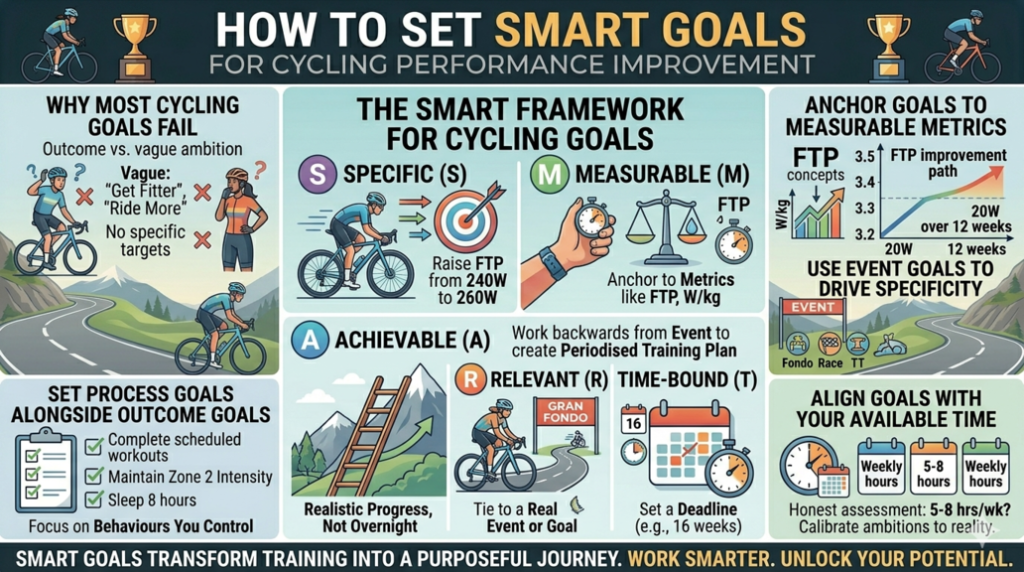
Most cyclists set goals that are too vague to act on. “Get fitter,” “ride more,” or “improve my climbing” are outcomes, not targets. Without specificity, you can’t build a training plan around them, can’t measure progress toward them, and can’t tell when you’ve achieved them. The result is unfocused training that produces unfocused results.
The SMART Framework for Cycling Goals
The SMART goal framework — Specific, Measurable, Achievable, Relevant, Time-bound — was designed for exactly this problem. Applied to cycling, it transforms vague ambitions into concrete, actionable targets. Instead of “improve my climbing,” a SMART goal might be: “Raise my W/kg ratio from 3.2 to 3.5 within 16 weeks by improving FTP through two structured threshold sessions per week.”
Anchor Goals to Measurable Performance Metrics
The best cycling goals are anchored to objective performance metrics that your devices already track. FTP is the most useful single metric for goal-setting because it directly relates to your ability to sustain effort across almost every cycling discipline. Setting a target FTP improvement — say, from 240W to 260W over 12 weeks — gives you a clear, measurable outcome that your training can be specifically designed to achieve. Understanding how long FTP improvement realistically takes helps you set a timeline that’s ambitious but achievable.
Use Event Goals to Drive Specificity
The most effective cycling goals are often tied to a specific event: a sportive, a race, a personal target on a key climb. Event goals force specificity — you know exactly when you need to peak and what demands the event will place on you. From there, you can work backwards to build a training plan that delivers peak fitness at exactly the right time. This approach of working backwards from an event is central to how coaches structure periodised training, and it’s the same logic that drives peaking strategies for cycling events.
Set Process Goals Alongside Outcome Goals
Outcome goals (raise FTP by 20W) are important, but they’re not fully within your control — physiology doesn’t always cooperate on schedule. Process goals focus on the behaviours you can control: complete every scheduled workout this week, maintain Zone 2 intensity on all endurance rides, sleep eight hours consistently. Process goals build the habits that make outcome goals achievable, and they’re motivating even on weeks when fitness isn’t visibly improving.
Align Goals with Your Available Time
The most ambitious goal in the world fails if it requires more training time than you actually have. Before committing to a target, honestly assess how many hours per week you can consistently train. Understanding how many hours a week a cyclist should train for different goals helps you calibrate your ambitions to your available time. A realistic goal that fits your life will always outperform an ambitious goal that doesn’t.
The Bottom Line
Smart goal-setting transforms training from a series of rides into a purposeful journey toward a specific outcome. Anchor your goals to measurable metrics, tie them to real events, set both outcome and process targets, and make sure they’re realistic given your available time. With clear goals as the foundation, your training plan — whether built by an AI platform or a human coach — has something concrete to optimise for.