
What Is W/kg?
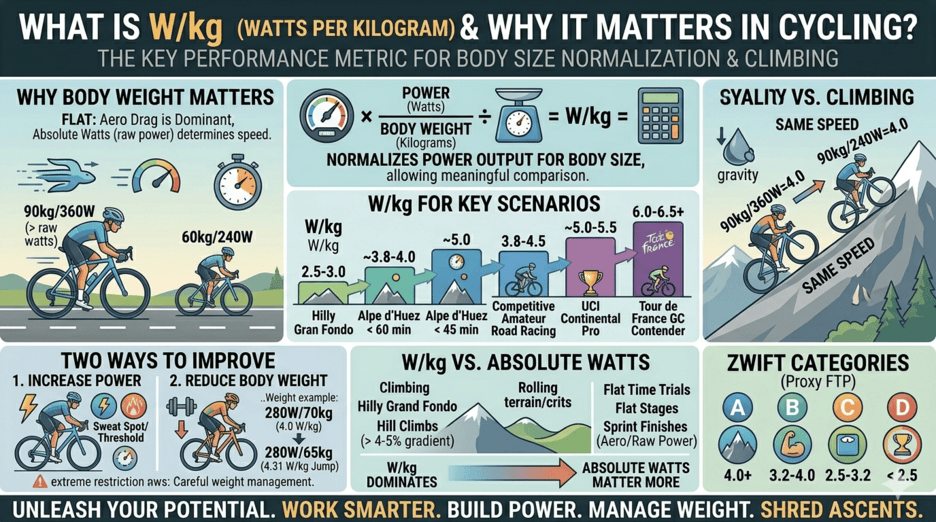
Watts per kilogram (W/kg) is the ratio of a cyclist’s power output to their body weight. It is calculated by dividing power in watts by body weight in kilograms. For example, a cyclist producing 280W at 70kg has a W/kg ratio of 4.0 W/kg.
W/kg is the most important single performance metric in road cycling because it normalizes power for body size — allowing meaningful comparison between cyclists of different sizes and weights. It is particularly critical for climbing performance, where gravity makes body weight a direct performance penalty.
Why Body Weight Matters in Cycling
On flat terrain, aerodynamic drag is the dominant resistance force. Absolute watts largely determine speed, and heavier riders can often produce more raw watts. But on climbs, gravity becomes the primary force you’re working against — and it scales directly with body weight.
A 90kg rider producing 360W and a 60kg rider producing 240W have identical W/kg (4.0). On a sustained climb, they will ride at essentially the same speed. The 90kg rider has 50% more power but also 50% more weight to lift — they cancel out.
W/kg for Key Cycling Scenarios
| Performance Target | Approximate W/kg Needed |
|---|---|
| Complete a hilly gran fondo | 2.5–3.0 W/kg |
| Alpe d’Huez under 60 minutes | ~3.8–4.0 W/kg |
| Alpe d’Huez under 45 minutes | ~5.0 W/kg |
| Competitive amateur road racing | 3.8–4.5 W/kg |
| UCI Continental Pro level | 5.0–5.5 W/kg |
| Tour de France GC contender | 6.0–6.5+ W/kg |
The Two Ways to Improve W/kg
1. Increase Power (Numerator)
Structured training that improves FTP directly raises your watt output. Sweet spot training, threshold intervals, and VO2 max work all contribute. This is the most reliable long-term path to higher W/kg and should be the primary focus for most cyclists.
2. Reduce Body Weight (Denominator)
Losing excess body fat while maintaining muscle mass improves W/kg without requiring any fitness gains. A 5kg weight loss at 4.0 W/kg with 280W output: 280W ÷ 65kg = 4.31 W/kg — a meaningful jump with no training change. However, extreme caloric restriction impairs training quality and recovery, so weight management must be approached carefully and sustainably.
W/kg vs. Absolute Watts: When Each Matters
W/kg dominates: Any climb over 4–5% gradient, mountain stages, hilly gran fondos, hill climbs.
Absolute watts matter more: Time trials on flat terrain, flat stages, sprint finishes (where aerodynamics and raw power output dominate).
Both matter equally: Rolling terrain with mixed gradients, criteriums with short punchy climbs.
Tracking Your W/kg Progress
Calculate your W/kg every time you retest your FTP. Keep a log of both your FTP in watts and your W/kg over time. This dual tracking shows whether improvements came from fitness gains, weight changes, or both — giving valuable insight into which lever is most productive for your performance goals.
Frequently Asked Questions
Is it better to increase power or lose weight to improve W/kg?
For most cyclists with significant fitness gains still available, increasing power is more productive and healthier. Weight loss helps most at higher fitness levels where power gains are harder to come by, or for riders carrying meaningful excess body fat.
Does W/kg matter for flat riders who don’t race mountains?
W/kg still matters on any gradient above 2–3%, and it remains the most useful metric for comparing fitness across different body types. Even flat riders benefit from understanding their W/kg trend over a training season.
How is W/kg calculated for racing categories on Zwift?
Zwift racing categories use W/kg based on your best 20-minute power as a proxy for FTP. Category A is typically 4.0+ W/kg, B is 3.2–4.0, C is 2.5–3.2, and D is under 2.5 W/kg.