
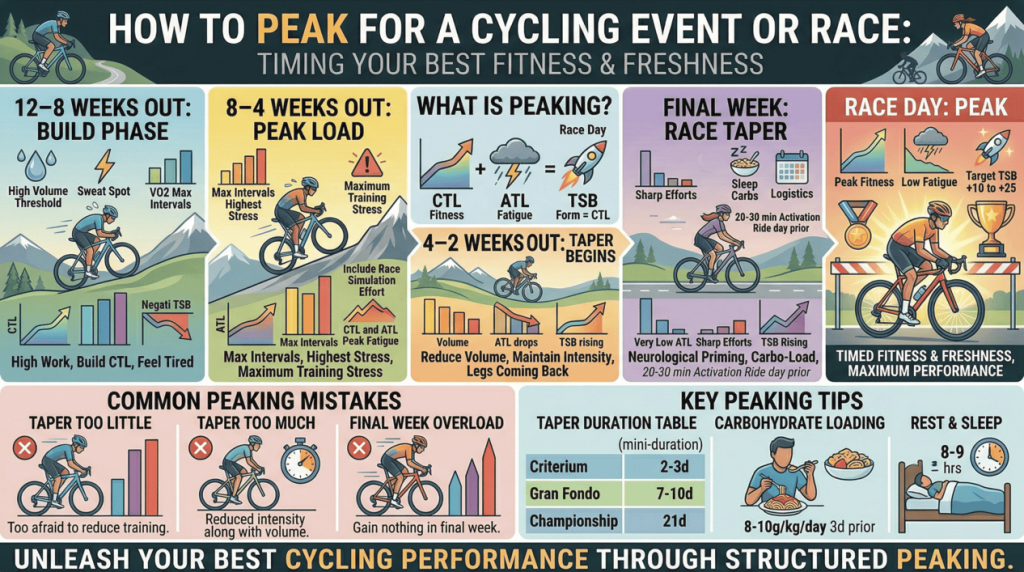
What Is Peaking in Cycling?
Peaking is the process of timing your highest level of fitness and freshness to coincide precisely with a target event. It’s not just about being fit — it’s about being fit and fresh at exactly the right moment. The science behind peaking involves manipulating your training load to maximize fitness while eliminating accumulated fatigue.
The metrics that capture this: CTL (fitness, built over months), ATL (acute fatigue, reduced through tapering), and TSB (form = CTL − ATL, the result you want positive on race day).
The Peaking Timeline
12–8 Weeks Out: Build Phase
This is when you do the hard work. High-volume training with sweet spot, threshold, and VO2 max intervals. CTL rises, ATL is high, TSB is negative. You feel tired — this is correct. Fitness is being built. Don’t panic about feeling heavy during this phase.
8–4 Weeks Out: Peak Load
Maximum training stress of the cycle. Longest intervals, highest weekly TSS. This is the point of peak fatigue before the taper begins. Some coaches include a race simulation effort (a hard group ride or local race) here to test race-specific fitness.
4–2 Weeks Out: Taper Begins
Reduce volume by 30–40% while maintaining intensity. Keep the hard sessions but shorten them. CTL drops slightly, ATL drops more, TSB begins rising toward positive. You should start feeling “the legs coming back.”
Final Week: Race Week Taper
Volume drops to 50–60% of normal peak. 2–3 short, sharp sessions with race-pace efforts to stay neurologically primed. No new training stress. Focus on sleep, nutrition, and logistics.
Race Day
Target TSB: +10 to +25 for most events. A short 20–30 minute activation ride the day before (with a few short efforts at race pace) keeps muscles primed without adding meaningful fatigue.
How Long Should Your Taper Be?
| Event Type | Taper Duration |
|---|---|
| Weekly local race / criterium | 2–3 days |
| Gran Fondo / Sportive | 7–10 days |
| A-Priority stage race or target event | 14–21 days |
| Championship / peak event of the year | 21 days |
Common Peaking Mistakes
Tapering too little: Showing up to a race still carrying two weeks of fatigue because you were afraid to reduce training. The most common mistake among amateur cyclists.
Tapering too much: Reducing intensity along with volume, leaving you feeling flat and derained on race day. Always maintain some intensity during the taper — just reduce the volume.
Doing too much the week before: One last big training ride 5–6 days before a key event is a classic mistake. You can’t gain fitness in the final week — you can only waste your existing form.
Ignoring sleep and nutrition: Peaking is about total readiness, not just training load. Prioritize 8–9 hours of sleep in the final two weeks, optimize carbohydrate intake, and stay well hydrated.
Nutrition During the Peak Phase
In the 3 days before a major cycling event, increase carbohydrate intake to top off muscle glycogen stores — a process called carbohydrate loading. Target 8–10g of carbohydrate per kilogram of body weight per day. Reduce fiber and fat intake to prevent GI issues on race day.
Frequently Asked Questions
Can I peak for multiple events in a season?
Yes, but with limits. Most cyclists can peak 2–3 times per year. Each peak requires a preceding build phase and a recovery period afterward. Trying to peak too frequently leads to chronic fatigue and declining performance.
What if I feel flat during my taper?
Taper blues are extremely common. The reduction in training volume causes many athletes to feel sluggish, anxious, and worried their fitness is disappearing. It isn’t — your body is consolidating adaptations. Trust the process and resist adding extra training.
How do I peak if I don’t have a power meter or training software?
Reduce overall ride time by 40% in the final 10 days. Keep 2 short, hard sessions with race-pace efforts. Avoid long rides in the final week. Rest, sleep, and eat well. The physiological principle is the same with or without data tools.