
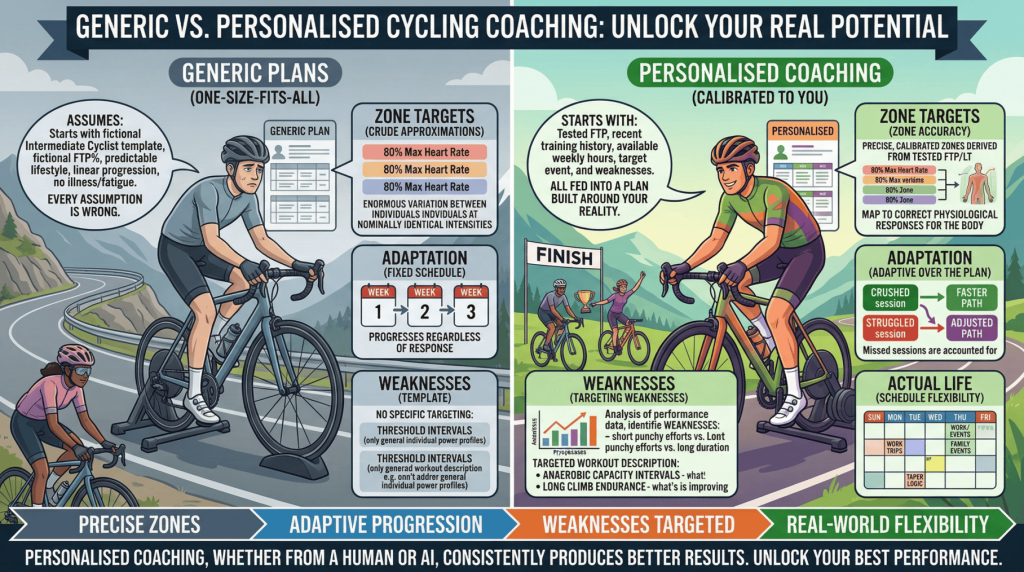
Download any training plan from the internet and you’ll get the same thing as thousands of other cyclists. Personalised coaching, by contrast, starts from where you actually are and builds a plan designed specifically for your physiology, goals, schedule, and training history. The difference isn’t cosmetic — it’s the difference between training that drives real improvement and training that produces mediocre results.
What Makes a Generic Plan Generic
A generic plan assumes a starting point — typically a fictional “intermediate cyclist” — and builds sessions around that assumption. The intensity targets are set at percentages of a theoretical FTP the plan has never measured. The weekly volume assumes a consistent lifestyle with predictable recovery. The progression assumes linear adaptation with no missed sessions, illness, or fatigue. Every one of these assumptions is almost certainly wrong for your specific situation.
How Personalised Coaching Starts Differently
A personalised coaching plan — whether from a human coach or an AI coaching platform — begins with your actual data. Your current FTP, your recent training history, your available weekly hours, your target event, and your specific weaknesses all feed into a plan that is built around your reality, not a template. This starting-point accuracy alone produces meaningfully better training outcomes.
Zone Targets Calibrated to You
One of the most important differences between generic and personalised coaching is zone accuracy. Generic plans assign intensity targets like “80% of max heart rate” — a crude approximation that varies enormously between individuals. Personalised coaching derives zones from your tested FTP or lactate threshold, meaning every prescribed intensity maps to the correct physiological response for your body. Understanding how training zones are calculated reveals just how much variation exists between individuals at nominally identical intensities.
Adaptation Over the Course of the Plan
Generic plans progress on a fixed schedule — week three is harder than week two regardless of how week two went. Personalised plans adapt based on how you actually responded. If you crushed a threshold session that was supposed to be challenging, a personalised plan moves you forward faster. If you struggled with a session that should have been manageable, it investigates why and adjusts accordingly. This adaptive quality is why adaptive training plans outperform fixed schedules over any meaningful training block.
Targeting Your Specific Weaknesses
Every cyclist has a different power profile — some are strong over long durations but weak in short, punchy efforts; others have excellent anaerobic capacity but a relatively modest FTP. Generic plans can’t address these individual differences because they weren’t designed with your profile in mind. Personalised coaching identifies your weaknesses from your performance data and targets them specifically. Understanding which metrics matter most for smart coaching helps you understand how your profile is being analysed and what the plan is designed to improve.
Fitting Training into Your Actual Life
A personalised plan also adapts to the reality of your schedule. If you can only train Tuesday, Thursday, Saturday, and Sunday, the plan reflects that. If you have a work trip that means missing three days, it adjusts. If you’re managing a family event the week before a key race, the taper accounts for it. Generic plans can’t do any of this — they assume the same schedule, the same life, every week.
The Bottom Line
Personalised cycling coaching differs from generic plans in almost every meaningful way: accurate zone calibration, adaptive progression, weakness targeting, and real-world schedule flexibility. Whether delivered by a human coach or an AI platform, personalised coaching consistently produces better results than any generic plan — because it’s built for the athlete who’s actually doing the training.