
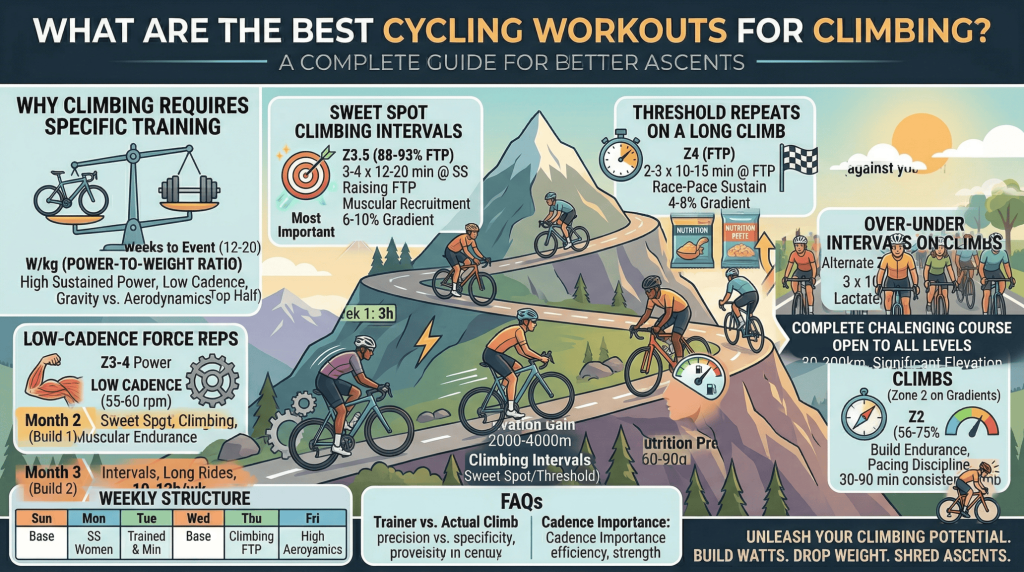
Why Climbing Requires Specific Training
Cycling climbs are uniquely demanding: sustained high power output, often at low cadence, over many minutes — sometimes hours. Unlike flat riding where aerodynamics dominates and raw watts matter most, climbing performance is almost entirely determined by your W/kg (watts per kilogram) — your power-to-weight ratio.
Improving as a climber requires either raising your FTP (more watts), reducing body weight, or both. The workouts below address all aspects of climbing-specific fitness.
The 6 Best Cycling Workouts for Climbing
1. Sweet Spot Climbing Intervals
What: Sustained efforts at 88–93% of FTP on a gradient of 6–10%.
Session: 3–4 × 12–20 minutes at 88–93% FTP, 5-minute recovery between efforts.
Why: Sweet spot is the most time-efficient zone for raising FTP. Doing it on an actual climb simultaneously develops the specific muscular recruitment and mental fortitude required for race climbs. This is the most important workout for improving climbing performance.
2. Threshold Repeats on a Long Climb
What: Efforts at 95–105% FTP on a sustained gradient.
Session: 2–3 × 10–15 minutes at FTP on a climb of 4–8%, full recovery between efforts.
Why: Directly trains your ability to sustain race-pace power output on climbs. Nothing better prepares you for a timed climb effort or mountain sportive finale.
3. Over-Under Intervals on Climbs
What: Alternating between just below and above FTP.
Session: 3 × 10 minutes: alternate 2 minutes at 95% FTP with 1 minute at 108% FTP.
Why: Simulates the surges and rhythm changes of group climbing and racing. Teaches your body to clear lactate during harder efforts — critical for sustained climbing in competitive situations.
4. Low-Cadence Force Reps
What: Climbing at 50–60 rpm at Zone 3–4 power (instead of normal 75–85 rpm).
Session: 4–6 × 5 minutes at 75–85% FTP at 55–60 rpm on a climb, 3-minute recovery.
Why: Builds leg strength and muscular endurance. Simulates the demands of steep gradients where even strong cyclists are forced into lower cadences. Improves your ability to push big gears on long ascents.
5. VO2 Max Repeats on Short Steep Climbs
What: Very hard 3–5 minute efforts on a steep gradient (8–12%).
Session: 5–6 × 3–4 minutes at 110–120% FTP on a steep climb, full 4-minute recovery.
Why: Raises your aerobic ceiling (VO2 max), which pulls your FTP upward over time. Short steep climbs are ideal because the gradient naturally keeps cadence manageable while power is very high.
6. Long Endurance Climbs (Zone 2 on Gradients)
What: Sustained easy riding on long climbs (30–90 minutes).
Session: 2–3 hours with a 30–60 minute consistent climb at Zone 2 (56–75% FTP).
Why: Builds climbing-specific endurance and fat oxidation at gradient. Teaches pacing discipline. Many cyclists discover they’ve been pushing Zone 3 on climbs they thought were Zone 2 — this workout corrects that tendency.
Weekly Climbing-Focused Training Structure
Tuesday: Sweet spot climbing intervals (60–90 min)
Thursday: VO2 max repeats on steep climb (75 min)
Saturday: Long ride featuring a sustained climb at Zone 2 (3–4 hours)
Sunday: Low-cadence force reps or threshold repeats (60–75 min)
Frequently Asked Questions
Should I train on actual climbs or is a trainer sufficient?
Both work well. A trainer with ERG mode is excellent for precise sweet spot and threshold work. Actual climbing adds specificity — gradient, technical demands, pacing, and mental training that a flat trainer can’t fully replicate. Combine both for the best results.
How long does it take to become a noticeably better climber?
With climbing-specific training, most cyclists see clear improvement on target climbs within 6–8 weeks. Personal best times on benchmark climbs typically improve by 5–15% over a dedicated 12-week climbing block.
Is cadence important for climbing?
Yes. Higher cadences (75–85 rpm on climbs) are more metabolically efficient and reduce muscular fatigue over long ascents. Many cyclists naturally slow their cadence on climbs — low-cadence strength work (workout #4 above) specifically addresses this weakness.