
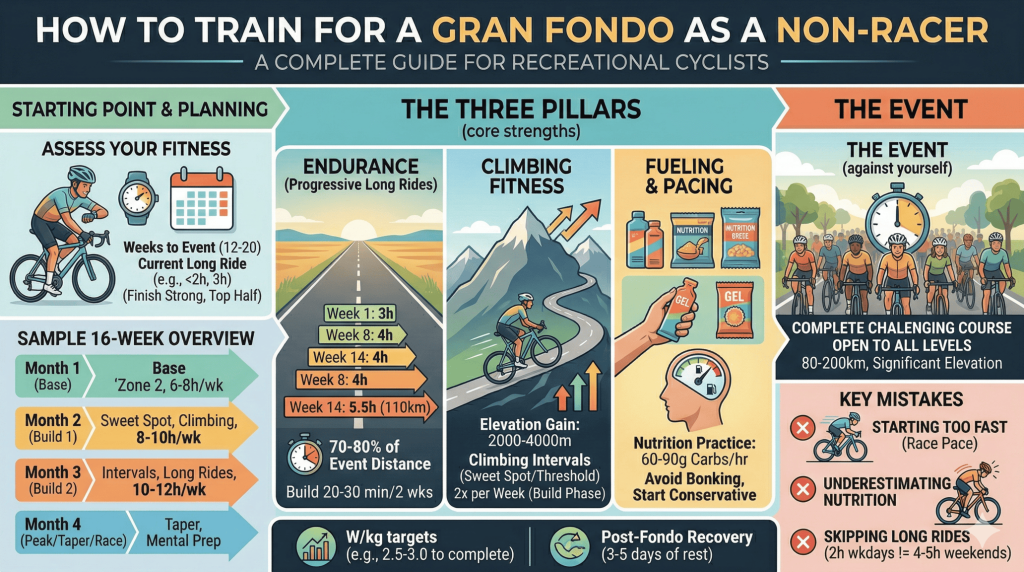
What Is a Gran Fondo?
A gran fondo is a long-distance mass-participation cycling event — typically 80–200km with significant elevation gain. Unlike a road race, gran fondos are open to all levels of cyclists. You’re not competing head-to-head for a podium; you’re completing a challenging course against the clock and against yourself.
For non-racers, the gran fondo is the perfect A-priority event: challenging enough to require months of structured preparation, but welcoming enough that any fit, well-prepared cyclist can successfully complete it and even achieve competitive times in their age category.
Assessing Your Starting Point
Before building your plan, honestly assess your current fitness. Key questions: What is your comfortable ride duration right now? How many hours per week can you consistently train? How much elevation gain are you accustomed to? What is your target completion time or goal (finish it, finish strong, finish in the top half)?
Most recreational cyclists need 12–20 weeks of preparation for a hilly gran fondo. If your current longest ride is under 2 hours, allow 16–20 weeks. If you’re regularly completing 3-hour rides, 12–14 weeks is sufficient.
The Three Pillars of Gran Fondo Preparation
1. Endurance (The Most Important Element)
Your ability to sustain effort for 4–7+ hours (typical gran fondo completion times for non-racers) is built primarily through progressive long rides. Build your weekly long ride duration by 20–30 minutes every 2 weeks. By race week, your longest training ride should reach 70–80% of the event distance.
For a 140km fondo: aim to complete a 100–110km training ride in the final 3–4 weeks before the event.
2. Climbing Fitness
Most gran fondos feature significant elevation gain (2,000–4,000m is common). Sweet spot and threshold intervals on actual climbs — or on a trainer — are essential. Do 2 climbing-focused sessions per week during your build phase: one sweet spot session and one longer, easier climbing endurance ride.
3. Fueling and Pacing Practice
Race nutrition is a trainable skill. Practice taking on 60–90g of carbohydrate per hour on long training rides. Experiment with different foods and products to find what works for your stomach. Pacing is equally important: start conservatively (hold back on the first climb even when you feel good) to avoid bonking in the final third of the event.
Sample 16-Week Gran Fondo Training Plan Overview
Weeks 1–4 (Base): Build long ride from current duration to 3 hours. Mostly Zone 2. 6–8 hours/week total.
Weeks 5–8 (Build 1): Introduce sweet spot intervals. Build long ride to 3.5–4 hours. Add climbing sessions. 8–10 hours/week.
Weeks 9–12 (Build 2): Increase interval intensity and duration. Long ride reaches 4–5 hours. Include one 5-hour ride. 10–12 hours/week.
Weeks 13–14 (Peak): Highest load. 5–6 hour long ride. Climbing-specific threshold work. 10–12 hours/week.
Weeks 15–16 (Taper): Reduce volume to 50–60%. Maintain some intensity. Rest and prepare mentally. Race in Week 16.
Key Mistakes Gran Fondo Non-Racers Make
Starting too fast: The atmosphere of a gran fondo start is electric and it’s easy to go out at race pace. This is the most common cause of a miserable last 40km. Start at a conversational effort regardless of the crowd around you.
Underestimating nutrition: Energy gels and bars feel unnecessary when you’re fresh. By hour 4, they are survival. Eat before you feel hungry, drink before you feel thirsty.
Skipping the long rides: Two-hour weekday rides cannot substitute for the weekly long ride. Endurance is built through time in the saddle, and nothing replaces the 4–5 hour weekend ride in fondo preparation.
Frequently Asked Questions
Do I need to race to train for a gran fondo?
Not at all. Gran fondos are explicitly designed for non-racers. A structured training plan focused on endurance, climbing, and nutrition preparation is everything you need — no racing experience required.
What W/kg do I need to complete a gran fondo?
Most gran fondos are completable at 2.5–3.0 W/kg with adequate endurance preparation. To finish in the top 30–40% of your category, aim for 3.3–3.8 W/kg.
How should I recover after a gran fondo?
Take at least 3–5 days of complete rest or very easy riding after a major fondo. A 140–180km event with 3,000m+ of climbing depletes glycogen, damages muscle tissue, and taxes your immune system. Rushing back to training in the week after a gran fondo is a common mistake that leads to illness and overtraining.