
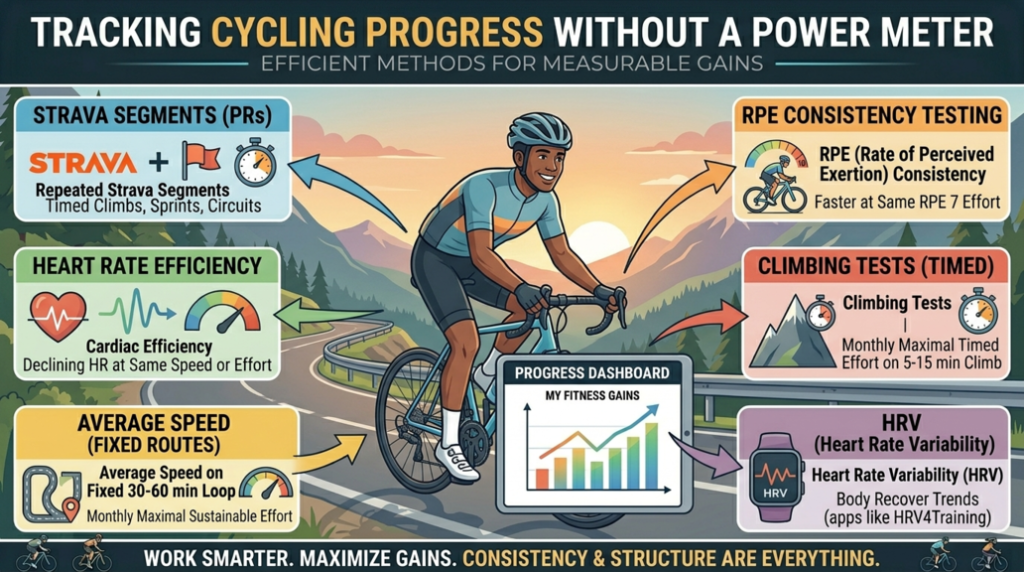
Can You Track Cycling Progress Without a Power Meter?
Absolutely. While a power meter is the gold standard for measuring cycling performance, it’s not a requirement for tracking meaningful progress. Millions of cyclists improve consistently using free or low-cost tools that, when used correctly, provide reliable performance data and training structure.
Method 1: Strava Segments and Personal Records
Strava’s segment system is one of the most powerful free tools for tracking cycling progress. By repeatedly riding the same climbs, sprints, or circuits, you create a performance timeline that clearly shows improvement over weeks and months.
Choose 3–5 key segments on routes you ride regularly — ideally a flat sprint, a moderate climb, and a longer sustained effort. Record your time and average speed each time. Improvement on consistent segments is a direct measure of fitness gains, even without power data.
Strava also automatically tracks your Personal Records (PRs) for best times at 5 seconds, 1 minute, 5 minutes, 10 minutes, 20 minutes, and 1 hour — giving you a built-in power curve equivalent based on speed.
Method 2: Heart Rate at Standard Efforts
Heart rate relative to effort is a reliable fitness indicator. As your aerobic fitness improves, your heart rate at a given speed or effort level decreases. This is called cardiac efficiency.
Create a test protocol: ride a fixed route or climb at a perceived effort of 7/10 and note your average heart rate. Repeat monthly. A declining heart rate at the same perceived effort = improved fitness. You can also track heart rate at a fixed speed — if you can maintain 25 km/h on flat ground at 140 bpm where it used to require 155 bpm, that’s clear, measurable progress.
Method 3: Rate of Perceived Exertion (RPE) Consistency Testing
RPE scales (typically 1–10 or the Borg 6–20 scale) allow you to standardize effort across rides. Choose a standard route and ride it monthly at exactly RPE 7. Track your average speed. Faster at the same RPE = improved fitness. This is low-tech but surprisingly accurate when applied consistently.
Method 4: Tracking Average Speed on Fixed Routes
Pick a 30–60 minute loop with consistent terrain and minimal traffic lights. Ride it monthly at your best sustainable effort. Your average speed is a direct proxy for power output at threshold. Plot it on a spreadsheet month over month. A rising trend line is all the motivation you need.
Method 5: Heart Rate Variability (HRV)
Free apps like HRV4Training or Elite HRV track your morning resting heart rate variability — a measure of autonomic nervous system recovery. While this doesn’t directly measure cycling fitness, it tells you whether your body is adapting well to training stress (improving HRV trend over weeks) or being overwhelmed by it (declining HRV).
Method 6: Climbing Tests
Find a local climb of 5–15 minutes. Do a maximal timed effort on it monthly. Your time is a highly reliable fitness proxy. As FTP improves, your climb time drops. This is essentially an outdoor time trial, and the data is just as valid as any lab test for tracking relative progress.
Building a Simple Progress Dashboard
Create a monthly spreadsheet tracking: best Strava segment times, average heart rate at fixed efforts, standard route average speed, body weight, and HRV trend. Updated monthly, this gives you a comprehensive fitness picture without spending a cent on a power meter.
Frequently Asked Questions
Is heart rate a good substitute for power?
For tracking progress over time, heart rate is very useful. For precise interval training, it lags behind actual effort by 30–60 seconds and is affected by heat, fatigue, and caffeine — making it less reliable for session-to-session intensity control than power.
When should I upgrade to a power meter?
When you’ve been training consistently for 6–12 months and want more precise control over your training zones and interval quality. Entry-level single-sided power meters now start around $200–$300, making them accessible to most serious cyclists.
Can I estimate my FTP without a power meter?
Approximately, yes. Using your best 20-minute average speed on a flat, consistent course and comparing to known power-to-speed relationships for your weight gives a rough FTP estimate. Apps like Best Bike Split can assist with this calculation.