
What Is Training Stress Score (TSS)?
Training Stress Score (TSS) is a numerical measure of the total training load from a single workout, developed by Dr. Andrew Coggan and Hunter Allen. It combines both the intensity and the duration of a ride into a single number that allows you to compare the physiological cost of completely different types of workouts.
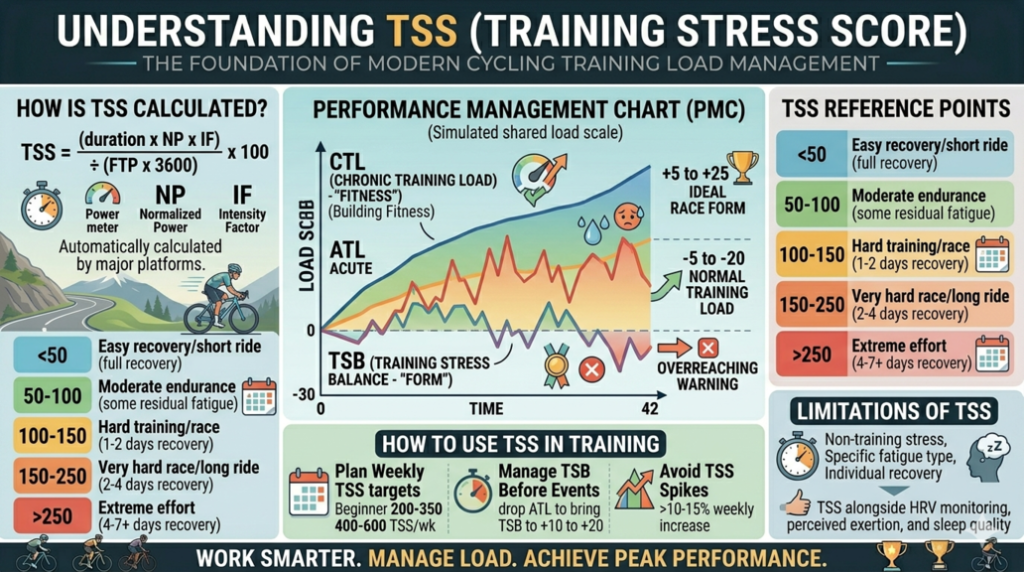
TSS is calculated using this formula: TSS = (duration in seconds × NP × IF) ÷ (FTP × 3600) × 100
Where NP is Normalized Power (a measure of power variability) and IF is Intensity Factor (NP ÷ FTP). You don’t need to calculate this manually — every major platform (TrainingPeaks, Garmin Connect, Strava Premium, Wahoo) calculates TSS automatically from your power meter data.
TSS Reference Points
| TSS Score | Workout Type | Recovery Needed |
|---|---|---|
| < 50 | Easy recovery or short ride | Full recovery by next day |
| 50–100 | Moderate endurance ride | Some residual fatigue next day |
| 100–150 | Hard training ride or race | 1–2 days to recover fully |
| 150–250 | Very hard race or long ride | 2–4 days to recover fully |
| > 250 | Extreme effort (gran fondo, stage race day) | 4–7+ days to recover fully |
The Three Key Metrics Built on TSS
CTL — Chronic Training Load (“Fitness”)
CTL is the rolling 42-day average of your daily TSS. It represents your current fitness level — how much training stress your body has adapted to absorb. A higher CTL means greater fitness. Building CTL is the long-term goal of any training program. Elite cyclists typically carry a CTL of 100–150+ during their competitive season.
ATL — Acute Training Load (“Fatigue”)
ATL is the rolling 7-day average of your daily TSS. It represents your recent fatigue level. After a hard training week, ATL spikes. During a recovery week, it drops. ATL tells you how tired you are right now.
TSB — Training Stress Balance (“Form”)
TSB = CTL − ATL. This is your “form” number. A negative TSB means you’re carrying fatigue (you’re working hard and building fitness). A positive TSB means your fatigue has decreased relative to your fitness — you’re fresh and ready to perform. The ideal TSB for peak race performance is typically between +5 and +25.
How to Use TSS in Your Training
Plan Weekly TSS Targets
Set a target weekly TSS that matches your training level and increases gradually over a training block. Beginner cyclists might target 200–350 TSS/week. Trained amateurs often aim for 400–600 TSS/week. This prevents both undertraining and the sudden jumps that cause overreaching.
Manage Your TSB Before Events
In the 1–2 weeks before an important event, reduce training volume to let ATL drop. This brings TSB from negative toward positive — the classic taper. Arriving at a race or gran fondo with a TSB of +10 to +20 is the sweet spot: fresh but not derained.
Avoid TSS Spikes
A sudden large increase in weekly TSS (more than 10–15% over the previous week) significantly raises injury and overtraining risk. TSS makes these spikes visible and quantifiable, allowing you to make smarter load management decisions.
Limitations of TSS
TSS is a powerful tool but not a complete picture. It doesn’t account for non-training stress (sleep deprivation, work stress, illness), the specific type of fatigue (muscular vs. cardiovascular), or individual recovery capacity. Use TSS alongside HRV monitoring, perceived exertion, and sleep quality for the most complete training picture.
Frequently Asked Questions
Do I need a power meter to use TSS?
Power-based TSS is most accurate, but heart rate-based estimates (hrTSS) are available in TrainingPeaks and provide useful approximations if you don’t have a power meter.
What TSS should I aim for per week as a beginner?
Start at 150–250 TSS/week and increase by no more than 10% per week. Let 3 weeks of building be followed by one recovery week at 60% of normal TSS.
Why is my TSB always negative even when I feel fine?
A slightly negative TSB (−5 to −20) during a training block is completely normal and means you’re accumulating fitness. Concern starts when TSB drops below −30 for extended periods without recovery weeks — this is a warning sign of overreaching.