
Why 12 Weeks Is the Sweet Spot for Structured Training
A 12-week training block is long enough to drive meaningful physiological adaptation — mitochondrial growth, FTP improvement, and endurance development all require 8–12 weeks of progressive stimulus to fully manifest. It’s also short enough to maintain focus, adjust to life circumstances, and retest your fitness with a clear before-and-after comparison.
Most elite cyclists structure their year around two or three 12-week blocks, each targeting different aspects of fitness.
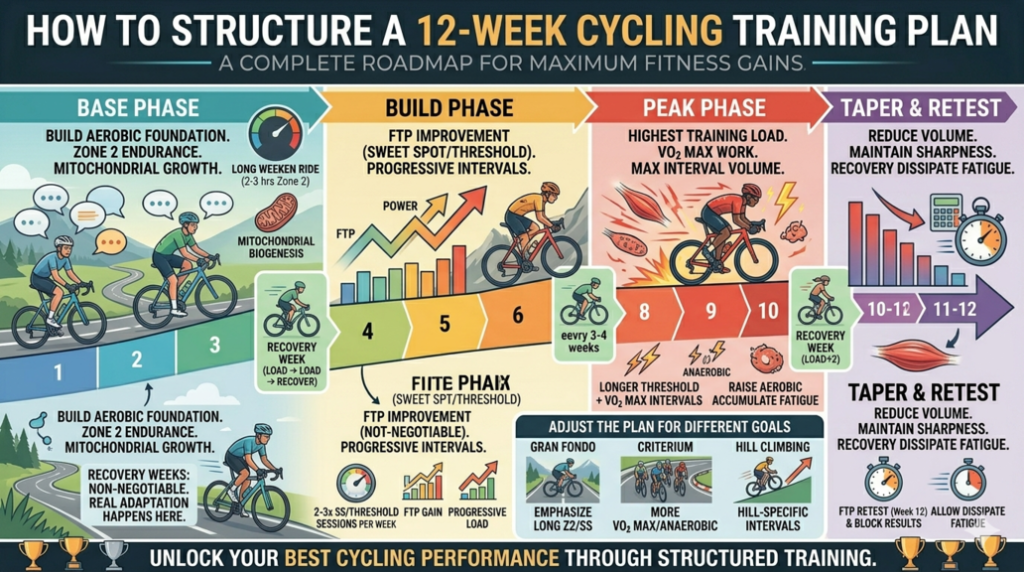
The Four Phases of a 12-Week Plan
Phase 1: Base (Weeks 1–3)
Build aerobic foundation with predominantly Zone 2 riding. Introduce structured workouts gradually. Focus on consistency and establishing the training habit. Volume is moderate, intensity is low. Key session: the long weekend ride (2–3 hours Zone 2).
Phase 2: Build (Weeks 4–7)
Introduce sweet spot and threshold intervals. Progressively increase interval duration. Maintain Zone 2 volume. This is where the bulk of FTP improvement occurs. Key sessions: 2–3 × sweet spot or threshold intervals per week.
Phase 3: Peak (Weeks 8–10)
Highest training load of the block. Maximum interval volume and some VO2 max work to raise the aerobic ceiling. Fatigue accumulates here — this is expected and productive. Key sessions: longer threshold intervals + VO2 max once per week.
Phase 4: Taper and Retest (Weeks 11–12)
Reduce volume by 40–50%. Maintain some intensity to stay sharp. Allow fatigue to dissipate so fitness becomes visible. Retest FTP in Week 12 to measure the block’s results.
Weekly Structure Template
| Day | Session Type | Duration |
|---|---|---|
| Monday | Rest or active recovery | 0–45 min |
| Tuesday | Interval session (sweet spot or threshold) | 60–90 min |
| Wednesday | Zone 2 endurance | 60–90 min |
| Thursday | Interval session (threshold or VO2) | 60–75 min |
| Friday | Rest or easy spin | 0–45 min |
| Saturday | Long ride (Zone 2 with tempo bursts) | 2–4 hours |
| Sunday | Recovery ride or rest | 45–60 min |
Recovery Weeks: The Non-Negotiable
Every third or fourth week should be a recovery week with 40–50% less volume and no hard intervals. This is when the real adaptation happens. Many cyclists make the mistake of skipping recovery weeks to squeeze in more training — this leads to overreaching, stalled progress, and injury.
A standard 12-week block looks like: Build, Build, Build, Recover, Build, Build, Build, Recover, Peak, Peak, Taper, Test.
How to Adjust the Plan for Different Goals
Gran Fondo preparation: Emphasize long Zone 2 rides and sweet spot work. Longer peak phase with 3–4 hour rides.
Criterium racing: More VO2 max and anaerobic work. Shorter but harder interval sessions. Sprinting practice in peak phase.
Hill climbing: Sweet spot and threshold work combined with weight management. Climbing-specific intervals on gradients of 6–10%.
Frequently Asked Questions
Can I follow a 12-week plan training only 5 days a week?
Yes. Remove the Wednesday Zone 2 session or combine it with Tuesday. The structure remains valid — prioritize the two interval sessions and the long weekend ride above all else.
What if I miss a week due to illness or travel?
Don’t try to make up missed training. Return to where you left off or step back one week in the progression. Trying to cram two weeks of training into one leads to injury and overtraining.
Should I follow the same 12-week plan multiple times?
You can repeat a plan, but increase the intensity or duration of intervals each time. Doing the exact same plan again provides diminishing returns since your body has already adapted to that specific stimulus.