
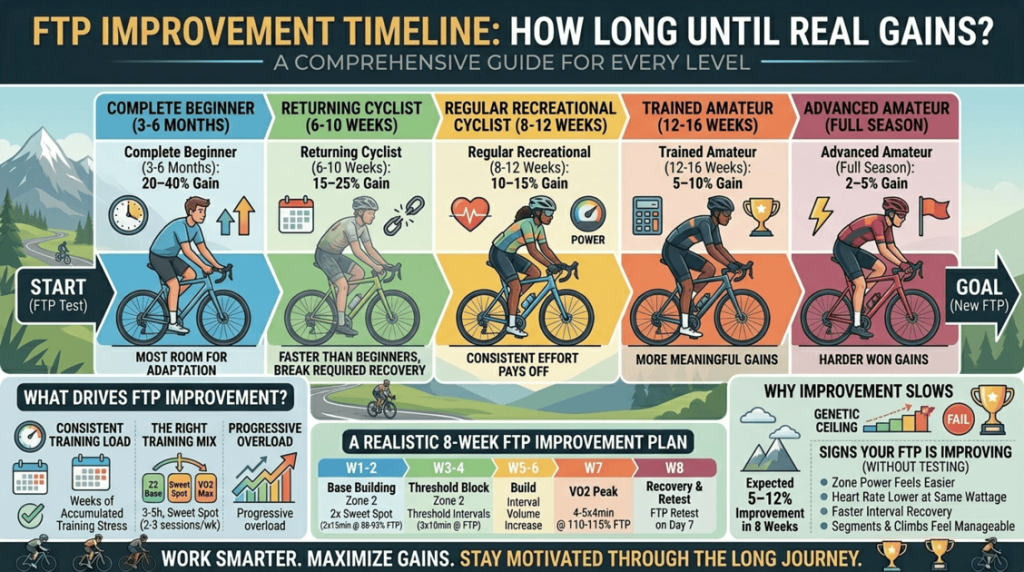
The Timeline for FTP Improvement
One of the most common questions from cyclists starting structured training is: how long until I see real FTP gains? The honest answer depends on your current fitness level, training history, and the quality of your training plan — but science and coaching experience give us clear guidelines.
FTP Improvement Timeline by Experience Level
| Cyclist Level | Expected FTP Gain | Timeframe |
|---|---|---|
| Complete beginner | 20–40% | 3–6 months |
| Returning cyclist (after a break) | 15–25% | 6–10 weeks |
| Regular recreational cyclist | 10–15% | 8–12 weeks |
| Trained amateur | 5–10% | 12–16 weeks |
| Advanced amateur / Category racer | 2–5% | Full training season |
The pattern is clear: beginners improve fastest because there’s the most room for adaptation. Advanced athletes gain less in percentage terms but those gains are harder won and more meaningful relative to the performance ceiling.
What Drives FTP Improvement?
Consistent Training Load
FTP doesn’t improve from a single hard workout — it improves from weeks of accumulated training stress followed by adequate recovery. The adaptation happens between hard sessions, not during them. Skipping recovery weeks undermines this process.
The Right Training Mix
The most effective combination for FTP improvement is: a strong Zone 2 aerobic base (3–5 hours/week), sweet spot intervals (2–3 sessions/week during a dedicated block), and occasional VO2 max work to raise the aerobic ceiling. Each element plays a distinct role in pushing your threshold upward.
Progressive Overload
Your training must progressively challenge your system. Riding the same routes at the same pace week after week produces fitness maintenance, not improvement. Structured plans that systematically increase interval duration or intensity over 8–12 weeks drive consistent FTP gains.
A Realistic 8-Week FTP Improvement Plan
Weeks 1–2: Base building. Mostly Zone 2 with 2 × sweet spot sessions per week (2 × 15 min at 88–93% FTP).
Weeks 3–4: Threshold block. Add threshold intervals (3 × 10 min at 95–100% FTP), increase sweet spot duration.
Weeks 5–6: Build. Increase interval volume (3 × 20 min sweet spot, 2 × 15 min threshold).
Week 7: VO2 peak. Add 2 sessions of 4–5 × 4 min at 110–115% FTP to raise the ceiling.
Week 8: Recovery and retest. Reduce volume to 50%, retest FTP on Day 7.
Following this structure, most cyclists see a 5–12% FTP improvement in 8 weeks.
Why FTP Improvement Slows Over Time
This is a fundamental principle of training science: the closer you are to your genetic ceiling, the smaller and harder each incremental gain becomes. A beginner going from 150W to 200W FTP gains 50W — a 33% improvement — in a few months. An advanced amateur going from 300W to 315W gains only 5% but may have spent an entire season achieving it.
This isn’t failure — it’s the normal physiology of adaptation. Managing expectations appropriately prevents frustration and helps you stay motivated through the long journey of cycling development.
Signs Your FTP Is Improving (Without Testing)
You don’t need to retest every few weeks to know you’re improving. Watch for these indicators: your target zone power feels easier than it did 4 weeks ago, your heart rate at a given wattage is lower than before, you recover faster between intervals, and segments or climbs you’ve ridden before now feel more manageable.
Frequently Asked Questions
Should I test my FTP every month?
Every 6–8 weeks is optimal. Testing too frequently wastes valuable training time and the fatigue from testing can disrupt your training block. Testing too rarely means your zones become inaccurate.
Why hasn’t my FTP improved despite months of training?
The most common causes are: training at similar intensities without progressive overload, insufficient recovery between hard sessions, underestimating Zone 2 volume, and not enough sleep. A smart coaching platform that tracks your Training Stress Balance (TSB) can identify which factor is limiting your progress.
Is it possible to improve FTP after age 40?
Absolutely. While VO2 max declines gradually after the mid-20s, FTP remains highly trainable into your 40s, 50s, and beyond with consistent structured training. Many masters cyclists achieve their best-ever power numbers in their 40s.