
What Is Zone 2 Training in Cycling?
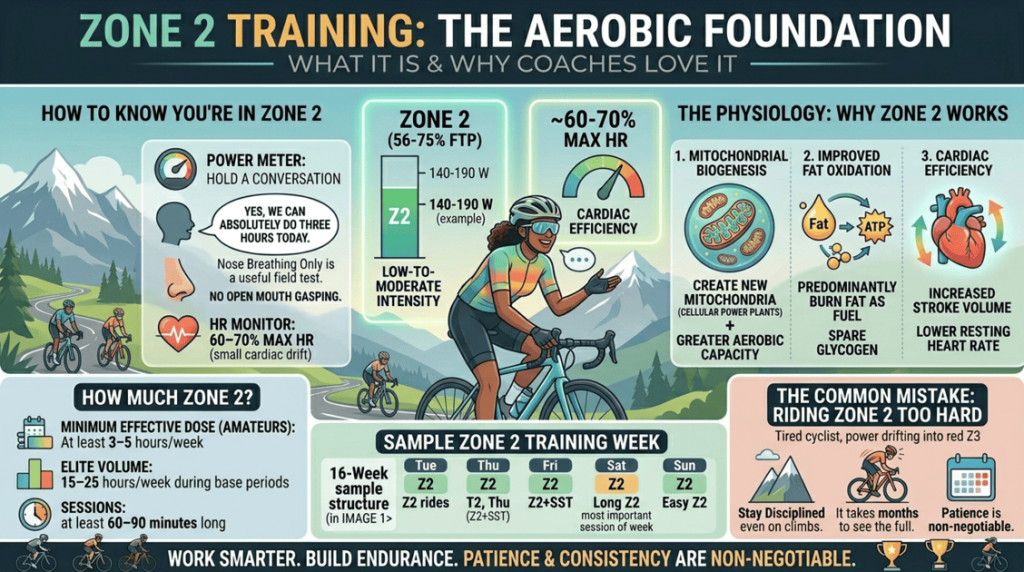
Zone 2 training refers to riding at a low-to-moderate intensity that corresponds to 56–75% of your FTP (Functional Threshold Power) or approximately 60–70% of your maximum heart rate. At this effort level, you can hold a full conversation, breathe easily, and feel like you could continue for hours — because you can.
Despite feeling almost too easy, Zone 2 riding is the foundation of virtually every elite endurance athlete’s training program. Sports scientists, coaches, and professional cyclists consistently identify it as the single most important training zone for long-term performance development.
The Physiology: Why Zone 2 Works
Zone 2 training primarily develops your aerobic energy system by forcing your body to rely predominantly on fat oxidation for fuel. This produces three critical physiological adaptations:
1. Mitochondrial Biogenesis
Zone 2 is the most potent stimulus for creating new mitochondria — the cellular power plants that convert oxygen and fuel into energy (ATP). More mitochondria means greater aerobic capacity, better fat burning, and a higher sustainable power output at any given effort level.
2. Improved Fat Oxidation
Training your body to efficiently burn fat as fuel spares glycogen for when you really need it — during hard climbs, attacks, or race-finishing efforts. A well-trained Zone 2 athlete can sustain 200–250W while burning almost entirely fat, preserving glycogen stores for hours longer than an untrained rider.
3. Cardiac Efficiency
Consistent Zone 2 work increases stroke volume (the amount of blood pumped per heartbeat), making your heart a more efficient pump. Over months and years, this shows up as a lower resting heart rate and lower heart rate at any given power output.
How to Know You’re in Zone 2
The most reliable way is a power meter: ride at 56–75% of your FTP. If your FTP is 250W, Zone 2 is 140–188W.
Without a power meter, use the talk test: you should be able to speak in full sentences without gasping. Nose-only breathing is another useful field test — if you can breathe exclusively through your nose, you’re almost certainly in Zone 2. If you need to open your mouth, you’ve likely drifted into Zone 3.
Heart rate monitors work too: aim for 60–70% of max heart rate. Be aware that heart rate can drift upward in heat or on long rides even at constant power — this is called cardiac drift and is normal.
How Much Zone 2 Should You Do?
The research is clear: more is better, up to the limits of your recovery capacity. Elite cyclists accumulate 15–25 hours of Zone 2 per week during base periods. Amateur cyclists should aim for at least 3–5 hours of Zone 2 per week as a minimum effective dose.
Sessions should ideally be at least 60–90 minutes long to fully engage the fat-burning and mitochondrial adaptation pathways. Shorter Zone 2 rides still have value but provide diminishing stimulus for the deep aerobic adaptations that make it so powerful.
Sample Zone 2 Training Week
Tuesday: 75-minute Zone 2 ride (steady, conversational effort)
Thursday: 60-minute Zone 2 + 2 × 8-minute sweet spot blocks
Saturday: 3-hour Zone 2 long ride (the most important session of the week)
Sunday: 90-minute easy Zone 2 recovery spin
The Common Mistake: Riding Zone 2 Too Hard
The biggest error most amateur cyclists make is riding Zone 2 too hard. What feels easy in the first 20 minutes often creeps into Zone 3 by the hour mark. Use a power meter and stay disciplined — even if it means slowing down on climbs to stay in zone. It takes months to see the full benefits of Zone 2 training, which is why so many riders abandon it prematurely.
Frequently Asked Questions
Is Zone 2 training just “junk miles”?
Absolutely not. Junk miles refers to riding at a moderate intensity that is too hard to allow recovery and too easy to drive high-end adaptations. True Zone 2 at 56–75% FTP is physiologically productive and forms the backbone of elite endurance training.
Can I do Zone 2 on a stationary bike or turbo trainer?
Yes — and it’s often easier to control intensity indoors where there are no hills or traffic forcing you above zone. ERG mode on a smart trainer holds your power precisely, making it ideal for Zone 2 sessions.
How long before I see results from Zone 2 training?
Expect 6–12 weeks before significant adaptation is visible in your performance data. The mitochondrial changes happen gradually. Patience and consistency are non-negotiable with Zone 2 training.