
The Most Common Question in Cycling Training
There is no single correct answer to how many hours a week a cyclist should train — it depends entirely on your current fitness level, goals, available time, life stress, and recovery capacity. However, there are well-established guidelines that apply to the vast majority of recreational and amateur competitive cyclists.
General Training Volume Guidelines by Level
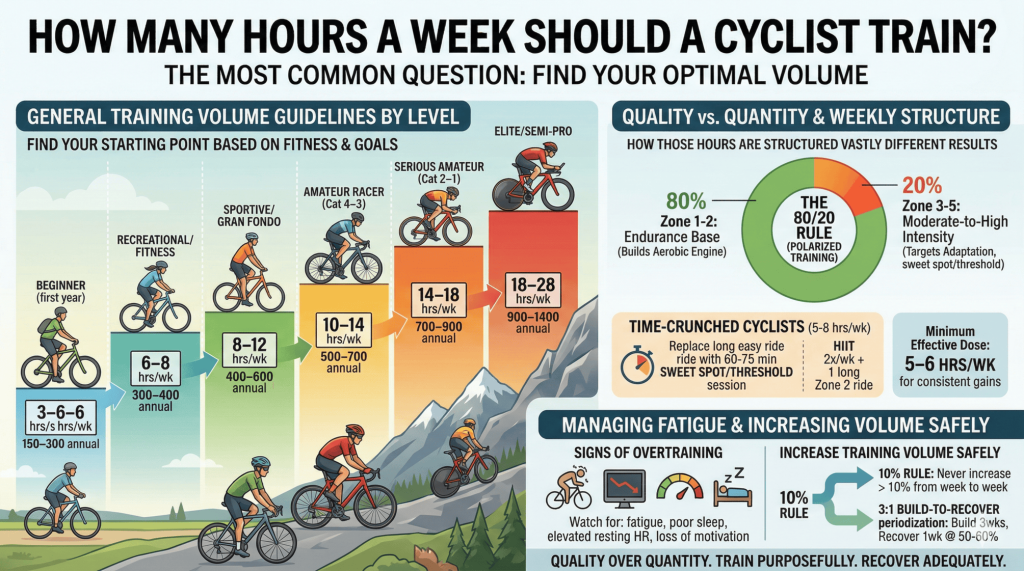
| Cyclist Level | Weekly Hours | Annual Hours |
|---|---|---|
| Beginner (first year) | 3–6 hrs | 150–300 hrs |
| Recreational/Fitness | 6–8 hrs | 300–400 hrs |
| Sportive/Gran Fondo | 8–12 hrs | 400–600 hrs |
| Amateur Racer (Cat 4–3) | 10–14 hrs | 500–700 hrs |
| Serious Amateur (Cat 2–1) | 14–18 hrs | 700–900 hrs |
| Elite/Semi-Pro | 18–28 hrs | 900–1400 hrs |
Quality vs. Quantity: Why Hours Alone Don’t Tell the Full Story
Two cyclists training 10 hours per week can achieve vastly different results depending on how those hours are structured. Ten hours of purposeful, zone-specific training — with proper recovery built in — will outperform 15 hours of unstructured riding every time.
This is the core principle behind smart, adaptive coaching: it’s not about maximizing volume, it’s about applying the right stress at the right time and recovering enough to absorb it.
How to Structure Your Weekly Training Hours
The 80/20 Rule (Polarized Training)
Research consistently shows that elite endurance athletes spend roughly 80% of training time in low intensity (Zone 1–2) and 20% in moderate-to-high intensity (Zone 3–5). This approach maximizes aerobic development while managing fatigue.
For a cyclist training 10 hours per week: 8 hours in Zone 1–2, 2 hours in Zone 3–5.
Minimum Effective Dose
Research suggests that 5–6 hours per week of structured training is the minimum effective dose to make consistent fitness gains. Below this, progress is slow and easily reversed by life disruptions.
How to Train with Limited Time (5–8 Hours/Week)
Time-crunched cyclists can still make significant fitness gains by prioritizing intensity over volume. Key strategies include:
Replacing one long, easy ride with a 60–75 minute sweet spot or threshold session saves 2–3 hours while maintaining most of the training stimulus. High-intensity interval training (HIIT) 2× per week plus one long Zone 2 ride is the most time-efficient training structure for busy cyclists.
Signs You’re Training Too Much
More hours don’t always mean more progress. Watch for these warning signs of overtraining: persistent fatigue that doesn’t resolve with rest, declining power numbers over several weeks, elevated resting heart rate, poor sleep quality, loss of motivation to ride, and frequent illness.
How to Increase Training Volume Safely
Follow the 10% rule: never increase weekly training volume by more than 10% from one week to the next. Build for 3 weeks, then take a recovery week at 50–60% of normal volume. This 3:1 build-to-recover ratio is the most widely used periodization structure in cycling.
Frequently Asked Questions
Can I get fit cycling just 3–4 hours a week?
Yes, especially if you’re a beginner or returning after a break. At 3–4 hours/week of structured training, you can absolutely build meaningful fitness. Progress will be slower than at higher volumes, but consistent improvement is achievable.
Is it better to ride every day or take rest days?
Most cyclists benefit from 1–2 full rest days per week, especially at training volumes under 12 hours. Active recovery rides (Zone 1, under 60 minutes) are fine on light days and promote blood flow without adding training stress.
How do I know if I’m doing enough?
Track your Training Load (CTL in Training Peaks or similar platforms). A slowly rising CTL over weeks and months indicates you’re accumulating productive fitness. Plateauing or declining CTL means volume or intensity needs adjustment.