
What Is FTP in Cycling?
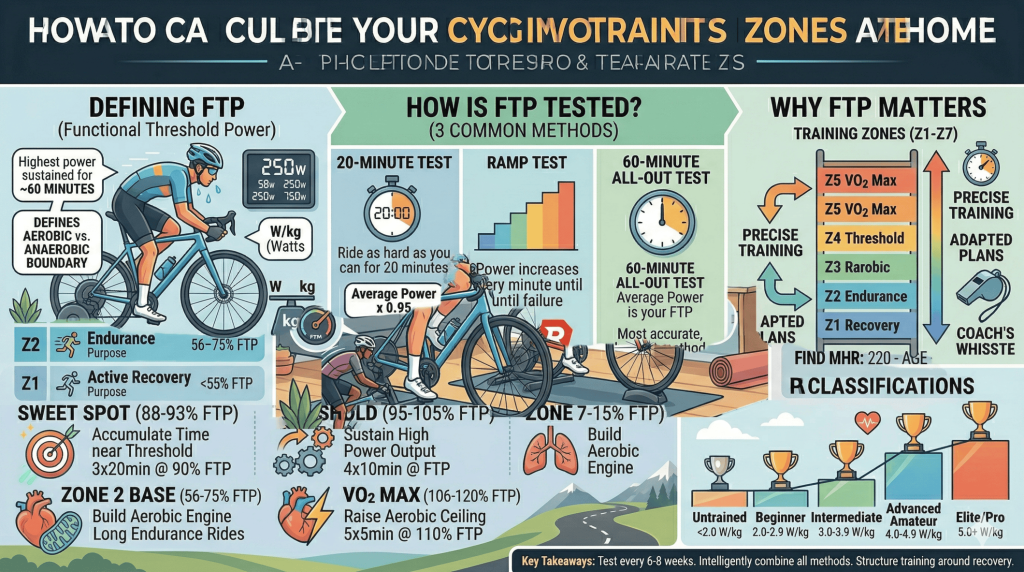
FTP, or Functional Threshold Power, is the highest average power output (measured in watts) you can sustain for approximately 60 minutes. It is the single most important metric in cycling training because it defines the boundary between your aerobic and anaerobic energy systems — and virtually every training zone is calculated from it.
FTP is expressed in watts (e.g., 250W) or, more meaningfully, as watts per kilogram (W/kg) to allow comparison across riders of different body weights. A 250W FTP on a 70kg rider equals 3.57 W/kg — a solid amateur level.
Why Does FTP Matter?
Your FTP determines your seven training zones, from active recovery (Zone 1) all the way to neuromuscular power (Zone 7). Training without knowing your FTP is like driving without a speedometer — you have no idea how hard you’re actually working or whether your sessions are producing the right adaptations.
Smart cycling coaches and AI-driven training platforms like Personal Best Pace use your FTP to build precise, personalized training plans that improve fitness without burning you out.
How Is FTP Tested?
There are several common testing protocols:
1. The 20-Minute FTP Test
Ride as hard as you can for 20 minutes. Take 95% of your average power as your FTP. This is the most widely used protocol because it’s less grueling than a full hour effort. Example: 20-min average = 280W → FTP = 280 × 0.95 = 266W.
2. The Ramp Test
Power increases by a fixed amount every minute until you can’t continue. Your FTP is estimated at 75% of your best one-minute power. This is now the most popular method on platforms like Zwift and TrainerRoad because it’s shorter and less mentally demanding.
3. The 60-Minute All-Out Test
The most accurate but hardest method. Your average power for the full hour is your FTP — no correction factor needed.
How Do You Improve Your FTP?
FTP improves through consistent, structured training that stresses your aerobic system just enough to force adaptation. The most effective methods include:
Sweet Spot Training
Riding at 88–93% of FTP (just below threshold) for extended intervals (15–40 minutes). This delivers the biggest FTP gains per training hour because it accumulates a lot of quality time near threshold without the deep recovery cost of full VO2 max work. Example workout: 3 × 20 minutes at 90% FTP with 5-minute rest.
Threshold Intervals
Riding at or slightly above FTP (95–105%) for 8–20 minute efforts. These directly train your ability to sustain high power output. Example: 4 × 10 minutes at FTP with 5-minute recovery.
Zone 2 Base Building
Long, easy aerobic rides at 56–75% FTP build the mitochondrial density and aerobic engine that supports all higher-intensity work. Without a strong aerobic base, threshold training has diminishing returns.
VO2 Max Intervals
Short, very hard efforts at 106–120% FTP for 3–8 minutes raise your aerobic ceiling, which in turn pulls your FTP upward. Example: 5 × 5 minutes at 110% FTP.
How Long Does It Take to Improve FTP?
Most cyclists see measurable FTP gains within 4–8 weeks of structured training. Beginners can improve FTP by 10–20% in their first training season. Experienced riders may only gain 2–5% per year, as gains become harder to achieve at higher fitness levels.
What Is a Good FTP?
| Level | W/kg (FTP) |
|---|---|
| Untrained | < 2.0 W/kg |
| Beginner | 2.0 – 2.9 W/kg |
| Intermediate | 3.0 – 3.9 W/kg |
| Advanced Amateur | 4.0 – 4.9 W/kg |
| Elite/Pro | 5.0+ W/kg |
Key Takeaways
FTP is the foundation of every good cycling training plan. Test it regularly (every 6–8 weeks), train across all zones based on it, and use a smart coaching platform to ensure your intervals are precisely dialed in. The fastest way to improve FTP is a combination of Zone 2 base work, sweet spot training, and periodic VO2 max intervals — structured intelligently around your recovery capacity.
Frequently Asked Questions
How often should I test my FTP?
Every 6–8 weeks is ideal. Testing too frequently wastes training time; testing too rarely means your zones become inaccurate as your fitness changes.
Can I improve FTP without a power meter?
Yes — you can use heart rate zones or RPE-based training, but a power meter gives you the most accurate and actionable data for FTP-based training.
Does losing weight improve FTP?
Your absolute FTP in watts may stay the same, but your W/kg improves as body weight decreases — which directly improves climbing performance and racing results.
Is a ramp test or 20-minute test more accurate?
The 20-minute test tends to be more accurate for experienced riders. The ramp test is better for beginners or those who struggle with pacing a 20-minute effort.