
If you’ve been cycling for a while or following a structured training plan, you’ve likely heard the term “sweet spot training.” It’s one of the most popular and effective training methods in cycling — and for good reason. But what exactly is it, and why do so many coaches and athletes swear by it?
Defining Sweet Spot Training
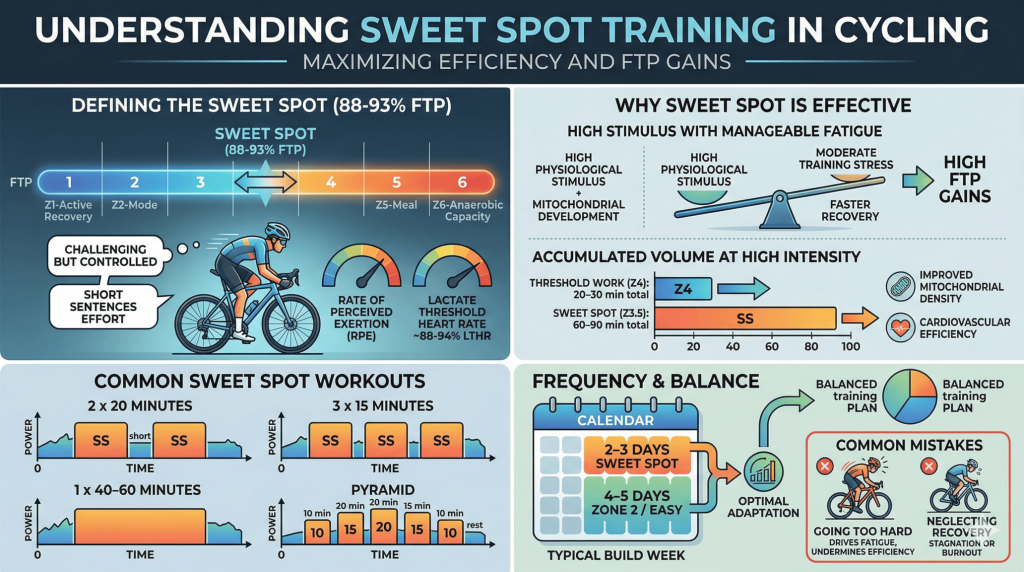
Sweet spot training refers to riding at an intensity between 88% and 93% of your Functional Threshold Power (FTP). It sits in the zone between tempo (moderate effort) and threshold (maximum sustainable effort) — hence the name “sweet spot.” It’s not easy, but it’s not all-out either. And that’s precisely what makes it so powerful.
In terms of heart rate, sweet spot typically corresponds to roughly 88–94% of your lactate threshold heart rate. If you’re training by feel rather than power, it’s the effort where you’re working hard enough that you can speak only in short sentences — challenging but controlled.
Why Sweet Spot Is So Effective
The magic of sweet spot training lies in its efficiency. Here’s why it delivers such strong results:
High training stimulus with manageable fatigue. Sweet spot efforts generate a significant aerobic adaptation response — stimulating your body to improve FTP, VO2 max, and muscular endurance — without the extreme fatigue of full threshold or VO2 max intervals. This means you can recover faster and train more frequently.
More training volume at high intensity. Because the effort is sustainable, you can accumulate far more time at a productive training intensity compared to all-out threshold work. An athlete might only sustain 20–30 minutes of pure threshold effort, but can ride 60–90 minutes total in sweet spot over a session.
FTP improvement. Consistently training in the sweet spot zone gradually raises your threshold power over time. It’s one of the most reliable methods for building a higher FTP.
Aerobic base development. Sweet spot training also develops your aerobic engine — increasing mitochondrial density, improving fat metabolism, and building cardiovascular efficiency that supports all types of riding.
What Does a Sweet Spot Workout Look Like?
Sweet spot workouts typically involve sustained efforts or intervals held at 88–93% of FTP. Here are some common formats:
2 x 20 minutes at sweet spot with 5 minutes recovery: A classic structure used by athletes at all levels. Both intervals challenge your threshold fitness while keeping recovery manageable.
3 x 15 minutes at sweet spot with 5 minutes recovery: Slightly shorter intervals, great for athletes newer to structured training or when building volume progressively.
1 x 40–60 minutes at sweet spot: A longer, sustained effort for more experienced riders looking to maximize aerobic development in a single block.
Sweet spot pyramid: Intervals of varying lengths (e.g., 10, 15, 20, 15, 10 minutes) with short rest periods between, adding variety while building volume over time.
How Often Should You Do Sweet Spot Training?
Sweet spot training is demanding enough that recovery must be respected. For most cyclists, 2–3 sweet spot sessions per week is appropriate during a dedicated build phase. The remaining training days should be filled with easy endurance riding (Zone 2) to allow adaptation and prevent overtraining.
Beginners might start with just one sweet spot session per week and build up gradually as their fitness and tolerance for training stress develop.
During race season or peak training phases, sweet spot volume may be reduced in favor of higher-intensity intervals that are more race-specific.
Common Mistakes to Avoid
Going too hard. Sweet spot is not a threshold or VO2 max effort. Many athletes push too hard and end up training above the zone, which drives up fatigue and undermines the efficiency advantage. If you have a power meter, stick to the numbers.
Neglecting recovery. Even though sweet spot is more sustainable than higher zones, it still accumulates significant training stress. Skipping easy days or compressing recovery leads to stagnation or burnout.
Ignoring other training zones. Sweet spot is a powerful tool, but it’s not the only one. Elite cyclists still dedicate significant time to Zone 2 base work and high-intensity efforts. A balanced training plan uses sweet spot strategically alongside other zones.
Conclusion
Sweet spot training sits at the intersection of high physiological stimulus and sustainable effort — which is exactly why it’s become a cornerstone of modern cycling training methodology. Whether you’re building your aerobic base in the off-season or maintaining fitness during a busy racing schedule, incorporating regular sweet spot sessions will reliably drive FTP gains and performance improvements. Work smarter, not just harder — and let the sweet spot do its job.