
You’ve been riding consistently. You’re putting in the hours. But your FTP hasn’t budged in months, your race times aren’t dropping, and that climb you’ve been chipping away at is still mocking you. You’ve hit a plateau — and steady-state riding isn’t going to break through it.
Intervals will.
Understand What Intervals Actually Do
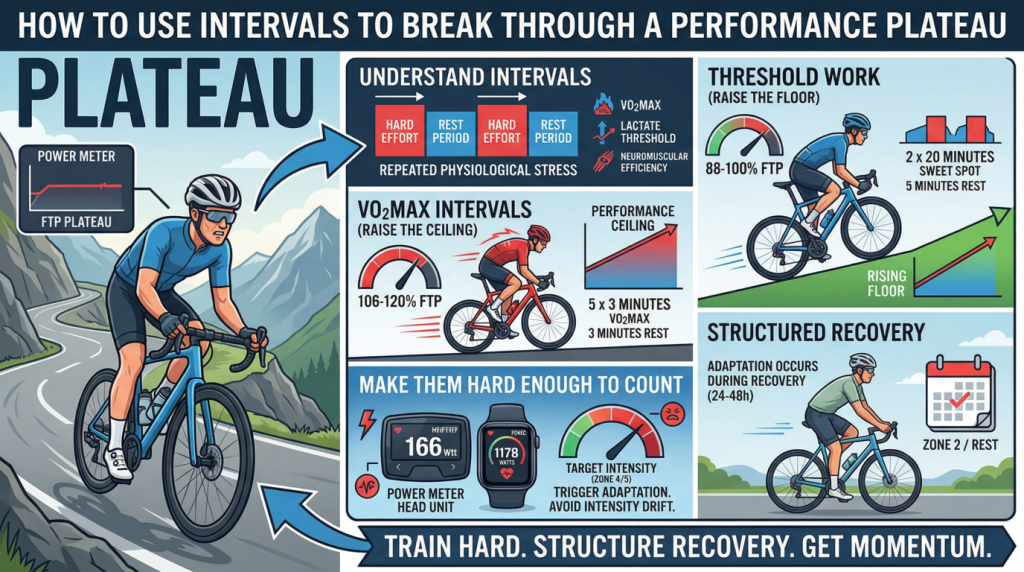
Interval training works by repeatedly stressing your physiological systems at intensities that create meaningful adaptation — then giving you just enough rest to do it again. The repeated dose of hard effort drives changes in VO2max, lactate threshold, and neuromuscular efficiency that easy riding simply can’t stimulate.
The key word is “structured.” Random hard efforts won’t move the needle the way a deliberate protocol will.
VO2max Intervals to Raise Your Ceiling
Short, hard intervals at 106–120% of FTP with equal rest periods target your aerobic ceiling — the maximum rate at which your body can use oxygen. A classic session: 5 x 3 minutes at VO2max intensity with 3 minutes easy between each. These are uncomfortable. They’re supposed to be. Done consistently over 4–6 weeks, they raise the ceiling that everything else sits under.
Threshold Work to Raise the Floor
Sweet spot and threshold intervals — ridden at 88–100% of FTP — build your ability to sustain high power for extended periods. Try 2 x 20 minutes at sweet spot with 5 minutes easy between. This is the workhorse of cycling training, and there’s a reason coaches keep coming back to it: it works.
Make Them Hard Enough to Count
A common mistake is drifting below the prescribed intensity because it “feels like enough.” Intervals have to hit their target range to trigger the intended adaptation. Use a power meter or, at minimum, a heart rate monitor and RPE scale to ensure your hard efforts are actually hard. Discomfort is part of the deal.
Structure the Recovery After Intervals
The day after an interval session should be easy — Zone 2 or full rest. Stacking hard days back-to-back without recovery prevents the adaptation you just worked so hard to stimulate. Intervals earn their results in the 24–48 hours after the session ends.
The plateau isn’t a dead end — it’s a sign you need to raise the stimulus. Show up to the hard session, do the work, and keep the momentum going.