
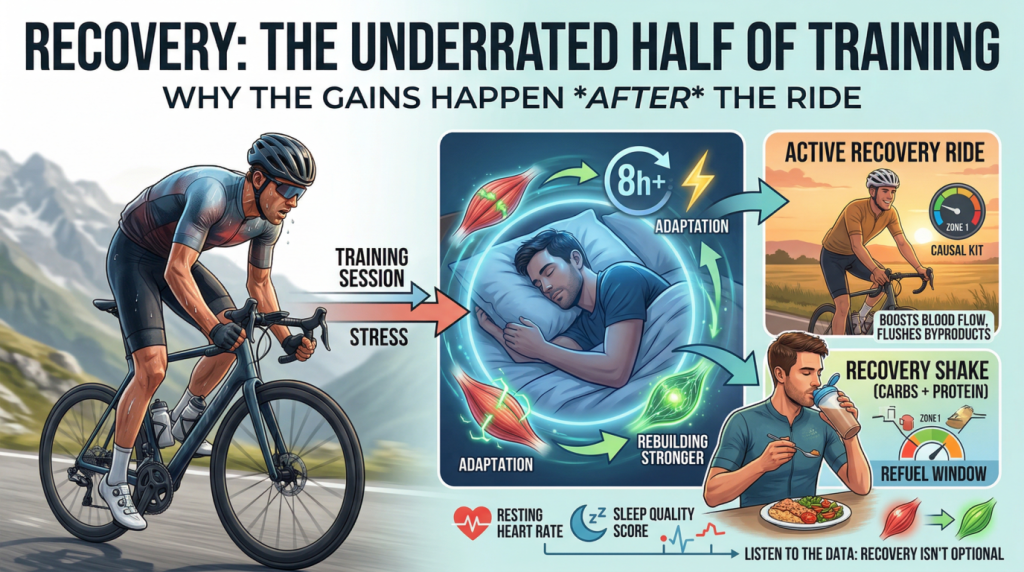
Here’s an uncomfortable truth: the training session itself doesn’t make you fitter. It breaks you down. What makes you fitter is what happens after — the hours and days your body spends rebuilding stronger than before. Recovery isn’t the passive part of training. It’s where the adaptation actually happens.
Yet most cyclists treat recovery as optional. They skip the easy day, cut the sleep short, and wonder why they feel flat at the start of every hard session.
Sleep Is the Most Powerful Recovery Tool You Have
There’s no supplement, compression garment, or ice bath that comes close to what quality sleep does for performance. During deep sleep, your body releases growth hormone, consolidates motor patterns, and repairs muscle tissue. Even one night of poor sleep measurably degrades power output and cognitive sharpness.
Aim for 7–9 hours consistently. If your schedule doesn’t allow for that, protect sleep before you protect any training session.
Active Recovery Rides Are Not Junk Miles
A 30–45 minute ride at genuinely easy effort — we’re talking 50–60% of max heart rate — increases blood flow, flushes metabolic byproducts, and keeps the joints moving without creating additional fatigue. Done right, an active recovery ride makes your next hard session better.
The key word is “genuinely easy.” If your easy rides creep up in intensity, you’re undermining the purpose entirely.
Fuel the Recovery Window
Within 30–45 minutes of a hard session, your muscles are primed to absorb glycogen and protein. A combination of carbohydrates and protein — a recovery shake, chocolate milk, or a proper meal — accelerates the repair process. Athletes who skip post-ride nutrition take longer to bounce back and perform worse in their next session. Don’t train hard and then starve the adaptation.
Watch for the Warning Signs of Accumulated Fatigue
Persistent muscle soreness, elevated resting heart rate, poor sleep quality, irritability, and declining motivation are all signs your body is asking for more recovery, not more riding. These signals aren’t weakness — they’re data. Learn to read them.
Train hard. Recover harder. The gains are waiting on the other side of rest.