
There’s a certain kind of suffering unique to a long climb — the kind where the gradient kicks up, your cadence drops, and every rider you’ve ever admired suddenly seems to be from a different species. Climbing is where fitness gaps get exposed. It’s also where they can be closed.
You don’t need to be born a climber. You need to train like one.
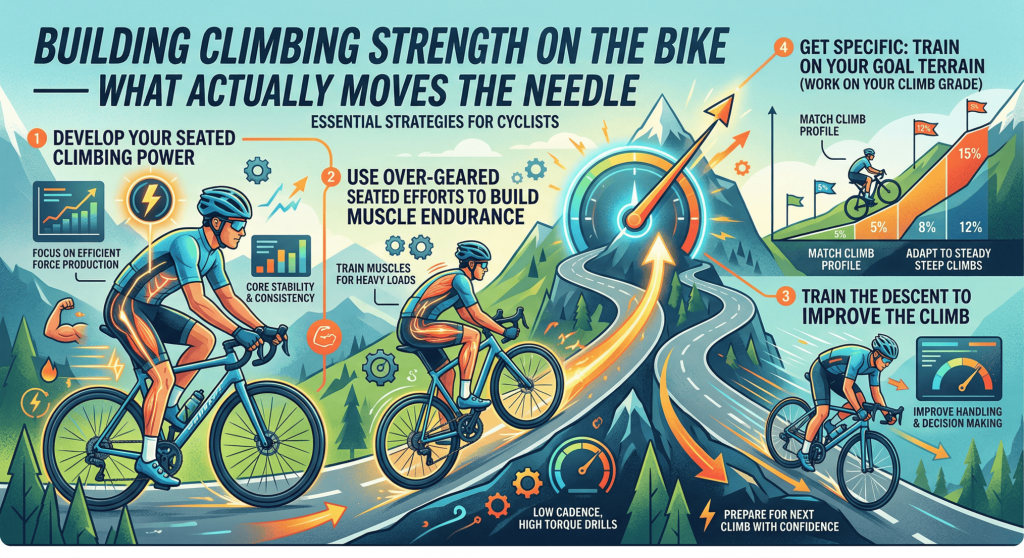
Develop Your Seated Climbing Power
The most efficient climbers spend the majority of their time seated, keeping heart rate controlled and power consistent. If you stand every time the road tilts, you’re burning matches that could be saved for later. Practice seated climbing at tempos that challenge you but stay sustainable — think 85–90% of threshold power for shorter climbs, lower for longer ones.
Seated climbing also demands core and hip stability. A strong, stable trunk keeps your pedal stroke efficient and prevents that side-to-side rocking that bleeds energy.
Use Over-Geared Seated Efforts to Build Muscle Endurance
Once a week, find a moderate incline and push a gear that’s deliberately harder than you’d normally choose. Keep your cadence around 60–65 RPM and hold the effort for 5–8 minutes, focusing on smooth, forceful pedal strokes. These low-cadence strength intervals develop the muscular endurance specific to climbing that regular road riding doesn’t quite replicate.
Recover fully between sets. This is strength work — treat it accordingly.
Train the Descent to Improve the Climb
Most climbers focus only on the ascent, but skilled descending means you arrive at the next climb with fresher legs. Practice cornering technique, braking efficiency, and body positioning on descents so you’re not white-knuckling it and wasting energy through tension.
Get Specific: Train on Your Goal Terrain
If your target event has long 8% grades, train on long 8% grades. Treadmills and trainers can simulate watts, but there’s no substitute for the neuromuscular specificity of actually climbing your target terrain. Map out local climbs of varying lengths and gradients and rotate through them intentionally.
Every climb you struggle with today is a climb you’ll own next season. Get on it.