
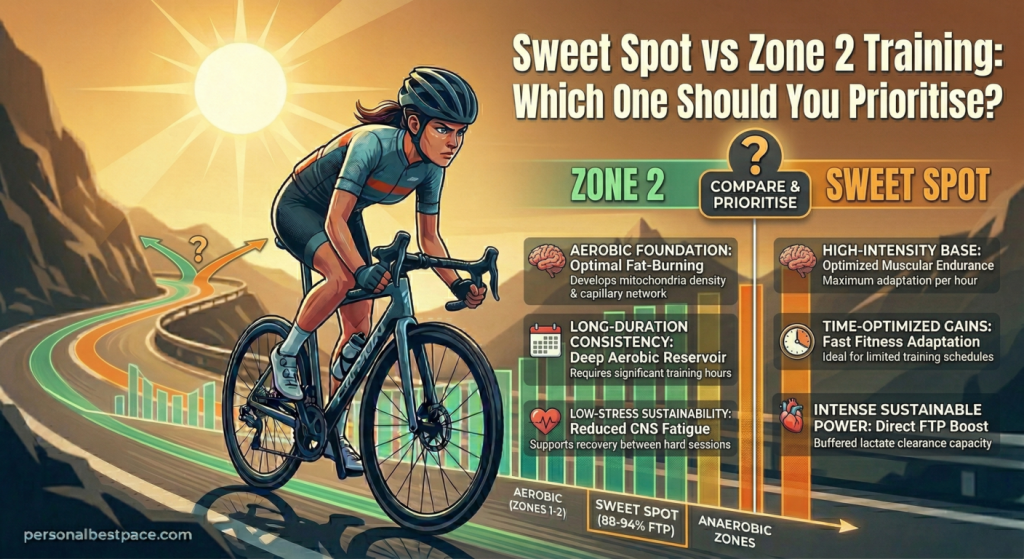
Ask ten experienced cyclists whether you should prioritise Zone 2 or sweet spot training and you will get ten different answers. Both approaches have strong arguments. Both produce real, measurable results. The truth is that the best answer depends on who you are, how much time you have, and where you are in your season — and the smartest approach is not to choose one over the other, but to understand when each is the right tool.
The case for Zone 2
Zone 2 builds your aerobic engine from the ground up. The adaptations it produces — increased mitochondrial density, improved fat oxidation, higher capillary density — are foundational. Without a large aerobic base, the ceiling on how much high-intensity work your body can absorb and recover from is structurally limited. The polarized training model, which emphasises 80% of riding at Zone 2 or below combined with a small amount of genuinely high-intensity work, is supported by research and is used by the majority of elite endurance athletes.
The limitation of pure Zone 2 is time. Meaningful aerobic base adaptations require long sessions at this intensity — ideally 90 minutes to 3 hours per ride. For riders who can only train 6 to 8 hours per week, spending all of it at Zone 2 may not produce enough total training stress to drive rapid improvement, especially in the shorter term.
The case for sweet spot
Sweet spot produces significant aerobic adaptations — particularly FTP gains — in less time per session than Zone 2. A 90-minute sweet spot session at 88% to 93% FTP produces more total training stress and drives more specific FTP adaptations than a 90-minute Zone 2 ride. For time-crunched cyclists who train 6 to 10 hours per week, sweet spot is one of the most efficient ways to improve over a 6 to 8 week block.
The limitation of relying too heavily on sweet spot is accumulated fatigue. Sweet spot is physiologically demanding — not as demanding as threshold or VO2max, but significantly more so than Zone 2. Multiple sweet spot sessions per week without adequate recovery will push your TSB into deeply negative territory, reducing the quality of subsequent sessions and limiting your ability to do the genuinely hard work when it matters.
What the science shows
Research on polarized versus threshold training models consistently shows that approaches emphasising high volumes of low-intensity work combined with smaller amounts of genuinely high-intensity work outperform approaches that do most of their training at moderate intensities. Sweet spot sits in the middle — it produces good results, but it may not be optimally efficient for all riders at all phases of the season.
The practical takeaway is not to choose one over the other, but to use each at the right time. Zone 2 builds the engine. Sweet spot tunes it. The sequence matters.
For the average cyclist — how to combine both across a season
The most effective approach for most amateur cyclists is a periodized mix that shifts the emphasis across the season. In winter base phase, the focus should be 80% to 90% Zone 2 with 10% to 20% sweet spot. In early build, shift toward 70% Zone 2, 20% sweet spot, and 10% threshold. In late build approaching a target event, use 60% to 70% Zone 2 with 20% to 30% threshold and VO2max, and minimal sweet spot. In the peak and race phase, maintain high Zone 2 volume, reduce sweet spot to near zero, and focus intensity on short sharp threshold and VO2max sessions.
The pattern is consistent across almost all periodized coaching models: build the aerobic base first, sharpen on top of it later. Sweet spot is most valuable in the transition from base to build — it bridges the gap between the sustained endurance of winter training and the higher intensities of race preparation.
For the advanced cyclist
Advanced cyclists typically use sweet spot more strategically — as a bridge between training phases, or as a maintenance stimulus during periods when racing prevents sustained high-intensity training blocks. The aerobic base built through years of Zone 2 work means that sweet spot sessions are more productive for experienced riders than beginners, because the aerobic foundation is already there to support the specific FTP-building stress that sweet spot delivers.
For riders at a higher level, the key question is not “Zone 2 or sweet spot?” but “what do I need most right now?” If CTL is low and fatigue is high, Zone 2 rebuilds. If CTL is solid but FTP is stagnating, a sweet spot block sharpens it. If an event is approaching, both drop in favour of intensity above threshold.
How PersonalBestPace manages the balance for you
PersonalBestPace’s AI coach manages the Zone 2 versus sweet spot balance automatically across your training plan. Based on your goal event date, your current CTL, your TSB, and how your body is responding to training load week by week, it shifts the intensity distribution across your season — more Zone 2 during base building, more sweet spot as your event approaches, and more threshold and VO2max in the final preparation phase. You can also ask the coach directly: “should this week be more base work or more intensity?” and it will answer based on your actual fitness numbers.
Try it free at app.personalbestpace.com
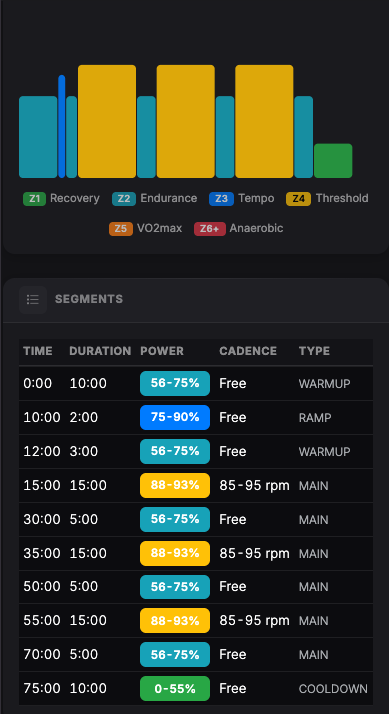
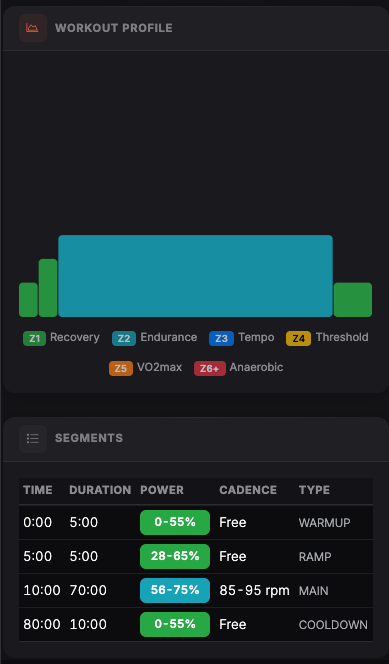
Side by side — Zone 2 vs Sweet Spot workout breakdown
Here is how the two approaches look in practice, using real workouts from PersonalBestPace. Both sessions are 90 minutes. The difference in structure, power targets, and physiological demands makes the contrast clear.
Endurance 90min — Zone 2 session
| Time | Duration | Power (% FTP) | Heart Rate | Cadence | Type |
|---|---|---|---|---|---|
| 0:00 | 5 min | 0–55% | ~60–65% max | Free | Warmup |
| 5:00 | 5 min | 28–65% | 65–72% max | Free | Ramp up |
| 10:00 | 70 min | 56–75% | 65–75% max | 85–95 rpm | Steady Zone 2 — continuous |
| 80:00 | 10 min | 0–55% | ~60% max | Free | Cooldown |
Sweet Spot 90min — sweet spot session
| Time | Duration | Power (% FTP) | Heart Rate | Cadence | Type |
|---|---|---|---|---|---|
| 0:00 | 15 min | 56–90% | 65–80% max | Free | Warmup + ramp |
| 15:00 | 18 min | 88–93% | 80–87% max | 85–95 rpm | Sweet spot interval 1 |
| 33:00 | 5 min | 56–75% | ~70% max | Free | Recovery |
| 38:00 | 18 min | 88–93% | 80–87% max | 85–95 rpm | Sweet spot interval 2 |
| 56:00 | 5 min | 56–75% | ~70% max | Free | Recovery |
| 61:00 | 18 min | 88–93% | 80–87% max | 85–95 rpm | Sweet spot interval 3 |
| 79:00 | 10 min | 0–55% | ~60% max | Free | Cooldown |
Both sessions are 90 minutes. The Zone 2 session produces TSS of 54 — the sweet spot session produces TSS of 77. The Zone 2 session can be repeated 3–4 times per week. The sweet spot session should appear at most twice per week, with recovery days between. Neither is better — they serve different purposes at different points in your season.