

VO2max training is where cycling gets serious. It is the zone that raises your aerobic ceiling — the maximum rate at which your body can consume and utilise oxygen. It is also the most demanding zone to train in, requiring the most recovery and producing the most significant fatigue. Used sparingly and at the right time in your season, VO2max work produces fitness gains that no other zone can match.
What is VO2max training?
VO2max is Zone 5 — typically defined as 106% to 120% of FTP, or the intensity at which you are operating near your maximum oxygen uptake. In heart rate terms, this is 90% to 100% of your maximum. The defining characteristic is that you cannot sustain VO2max intensity for more than 3 to 8 minutes per interval — the effort is simply too high to maintain for longer.
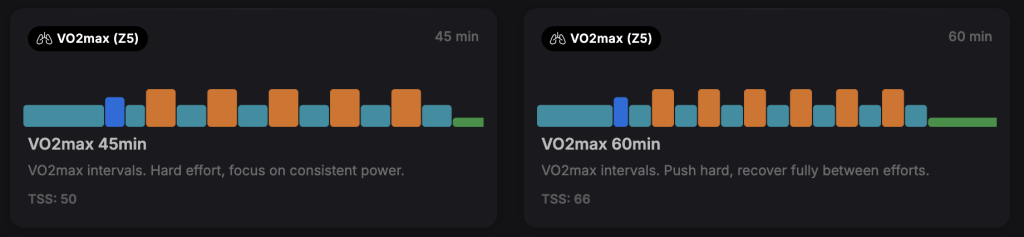
Common VO2max interval structures include 3 to 5 minutes at 110% to 120% FTP with equal recovery, or the popular 40-20 format — 40 seconds at maximum aerobic effort, 20 seconds of easy spinning, repeated 8 to 15 times. Both formats stress the same underlying system but the 40-20 structure allows more total time at near-VO2max intensity per session.
What VO2max training does to your body
VO2max training directly raises the maximum rate at which your cardiovascular system can deliver oxygen to working muscles. The key adaptations include increased cardiac output at maximum effort, raised stroke volume (the amount of blood pumped per heartbeat), improved oxygen extraction at the muscle level, and enhanced buffering of lactate at very high intensities.
The practical result is that your power output at all intensities becomes higher relative to your physiological cost. In race terms, this means faster accelerations, stronger climbing, a higher ceiling for sustained efforts in the final part of an event, and improved ability to respond to hard attacks in group rides.
For the average cyclist
For most amateur cyclists, VO2max work should be limited to one session per week, done only when TSB is neutral or positive, and only during build and race-preparation phases — not during base building. Starting with shorter intervals of 3 to 4 minutes at 110% FTP and progressing to 5-minute efforts over 4 to 6 weeks is appropriate for riders new to Zone 5 training.
The most important rule: VO2max intervals must be genuinely hard. If you complete 5 intervals and feel fine at the end, either you are undertesting your FTP or your target power is too conservative. These sessions should leave you genuinely spent — not destroyed, but clearly at the limit of what was sustainable.
For the advanced cyclist
Advanced cyclists incorporate VO2max work in their build and peak phases, after an aerobic base has been established through Zone 2 and sweet spot work. The 40-20 format is popular at this level because it allows more total time at near-VO2max intensity per session. A standard advanced VO2max block runs for 3 weeks — progressing from 4×4 minutes at 110% FTP to 5×5 minutes — followed by a rest week, then a second 3-week block.
Total VO2max interval time per session rarely needs to exceed 20 to 30 minutes. More is not better at this intensity — it is simply more expensive to recover from without proportionally more adaptation.
What happens when you overdo VO2max
VO2max is the most dangerous zone to overdo in terms of accumulated fatigue. A single hard session can push your ATL up significantly. Two sessions in one week without adequate recovery produces a deeply negative TSB that takes 5 to 7 days to recover from properly. Three or more consecutive weeks of VO2max work without a rest week will, for most cyclists, result in classic overreaching: flat legs, elevated resting heart rate, disturbed sleep, loss of motivation, and declining performance across all zones — including easy Zone 2 rides.
The rule: no more than 2 VO2max sessions per week, never on consecutive days, always with at least one full Zone 2 or recovery day between them, and a full rest or reduced-volume week every third or fourth week. Monitoring your TSB is the clearest objective signal — if it drops below -25 and stays there, your VO2max volume needs to come down.
VO2max workouts in PersonalBestPace
PersonalBestPace includes a full range of VO2max workouts — standard long intervals, 40-20 formats in multiple lengths, pyramid sessions, and progressive builds — from 30 to 75 minutes. The AI coach places these sessions strategically within your training week, always checking your TSB before scheduling high-intensity work and ensuring adequate recovery follows each VO2max session. You can also ask the coach: “am I ready for a VO2max session today?” and it will check your numbers and give you a direct answer.
Try it free at app.personalbestpace.com
VO2max 60min — workout breakdown
Here is the full segment breakdown for the VO2max 60min workout from PersonalBestPace. Six 3-minute intervals at 106–120% FTP with 3-minute full recoveries between each — a classic VO2max session structure that allows high-quality efforts without accumulating excessive fatigue between intervals.
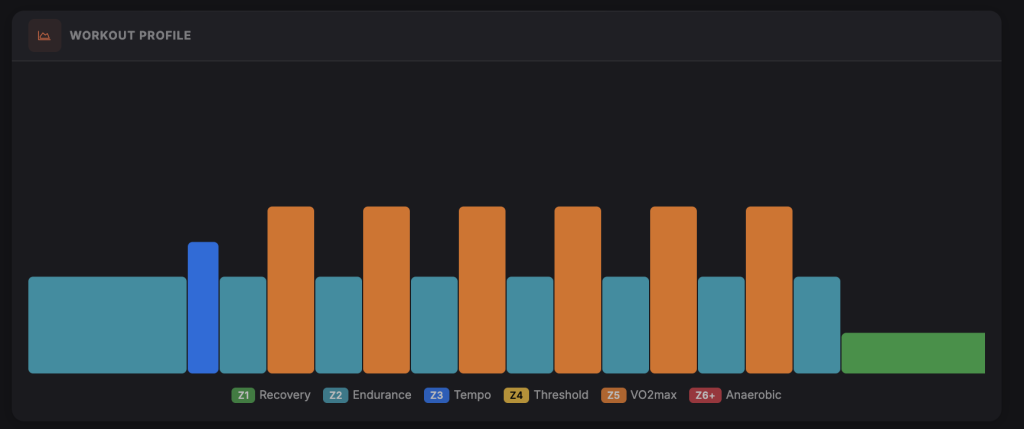
| Time | Duration | Power (% FTP) | Heart Rate | Cadence | Type |
|---|---|---|---|---|---|
| 0:00 | 10 min | 56–75% | ~65–72% max | Free | Warmup |
| 10:00 | 2 min | 81–97% | 75–85% max | Free | Ramp up |
| 12:00 | 3 min | 56–75% | ~68% max | Free | Warmup settle |
| 15:00 | 3 min | 106–120% | 88–96% max | 95–105 rpm | VO2max interval 1 |
| 18:00 | 3 min | 56–75% | ~74% max | Free | Recovery |
| 21:00 | 3 min | 106–120% | 90–97% max | 95–105 rpm | VO2max interval 2 |
| 24:00 | 3 min | 56–75% | ~74% max | Free | Recovery |
| 27:00 | 3 min | 106–120% | 90–97% max | 95–105 rpm | VO2max interval 3 |
| 30:00 | 3 min | 56–75% | ~74% max | Free | Recovery |
| 33:00 | 3 min | 106–120% | 90–97% max | 95–105 rpm | VO2max interval 4 |
| 36:00 | 3 min | 56–75% | ~74% max | Free | Recovery |
| 39:00 | 3 min | 106–120% | 90–97% max | 95–105 rpm | VO2max interval 5 |
| 42:00 | 3 min | 56–75% | ~74% max | Free | Recovery |
| 45:00 | 3 min | 106–120% | 90–97% max | 95–105 rpm | VO2max interval 6 |
| 48:00 | 3 min | 56–75% | ~72% max | Free | Recovery |
| 51:00 | 10 min | 0–55% | ~60% max | Free | Cooldown |
Total work time: 6 × 3 min = 18 minutes at VO2max. TSS: 66. Heart rate at VO2max intensity typically lags behind power — you may not see peak HR until 60–90 seconds into each 3-minute interval. By intervals 4–6, HR will likely hit 90–97% of max and stay there throughout the effort. The 3-minute recovery is deliberately equal to the work interval — resist the temptation to shorten it. Full recovery between efforts is what allows each subsequent interval to be done at true VO2max intensity. see a calculator here : VO2 Max and training calculators