
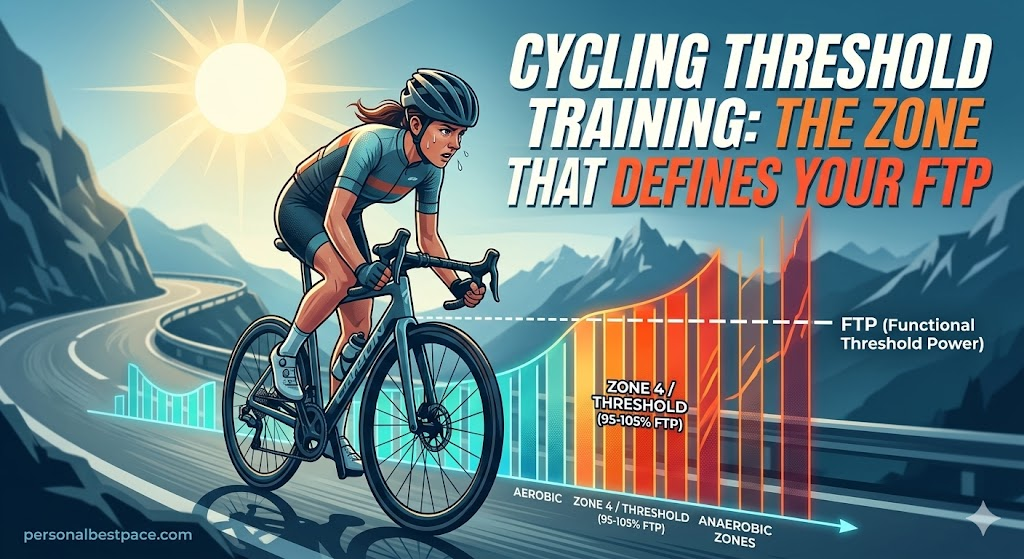
Threshold training is the most direct route to a higher FTP. It is also the easiest zone to overdo. Done right, threshold work produces sharp, measurable fitness gains over a 4 to 6 week period. Done wrong, it leaves you chronically fatigued and unable to complete the sessions that were supposed to make you faster.
What is threshold training?
Threshold is Zone 4 — defined as the intensity at or very close to your Functional Threshold Power. In percentage terms, this is typically 95% to 105% of FTP. It is the highest effort you can sustain for approximately 60 minutes in a maximal effort, though most training sessions use intervals of 8 to 20 minutes at this intensity rather than a continuous 60-minute effort.
The subjective feel at threshold is genuinely hard. Breathing is laboured, speech is limited to a few words, and by the end of each interval you are close to the limit of what you can sustain. Threshold is not comfortable. That is the point — and also what makes it so easy to misjudge.
What threshold training does to your body
Training at and around FTP directly raises the power output at which lactate begins to accumulate rapidly — which is, by definition, what it means to raise your FTP. The key physiological adaptations include increased density of oxidative enzymes in your muscle fibres, improved ability to buffer and clear lactate at high power outputs, raised cardiac output at sustained efforts, and improved neuromuscular efficiency at high intensities.
Threshold training also has a significant psychological component. Learning to sustain hard effort, maintain form when fatigued, and manage discomfort at high intensity are skills that transfer directly to racing and hard group rides. Athletes who train at threshold regularly become measurably better at pacing hard efforts than those who avoid the zone.
For the average cyclist
For most amateur cyclists, one threshold session per week is sufficient — and even that should only be done when your TSB is close to neutral or positive. Threshold work done with a deeply negative TSB (high accumulated fatigue) rarely produces the target power numbers and does not drive the same adaptations as the same workout done when fresh.
A standard session structure: 10-minute warmup, 2 to 3 intervals of 8 to 12 minutes at 95% to 105% FTP with equal recovery between efforts, 10-minute cooldown. Start with shorter intervals (2×8 minutes) and build the duration across a 6-week block. The goal is consistent power output from start to finish of each interval — not a heroic first effort that collapses by the third repeat.
For the advanced cyclist
Advanced cyclists use threshold work as the primary intensity in their build and pre-race phases. The progression typically runs from shorter intervals (2×10 minutes) to longer efforts (3×15 minutes, then 2×20 minutes) over 6 to 8 weeks. Some riders also use over-under intervals — alternating between slightly below and slightly above FTP within a single interval — to stress lactate clearance systems more specifically.
The 90-minute threshold session in PersonalBestPace is an extended format designed specifically for advanced riders building FTP — it accumulates a TSS of 86, which is significant but recoverable within 48 to 72 hours for trained athletes.
What happens when you overdo threshold
Threshold overtraining is one of the most common causes of fitness plateaus in amateur cycling. The problem is that threshold feels productive — you are working very hard, you finish sessions exhausted, surely it must be working. But threshold done too frequently or with insufficient recovery drives your ATL up faster than your CTL can adapt, pushing your TSB deeply negative and reducing the quality of every subsequent session.
The warning signs: you start threshold intervals and cannot hit target power despite full effort, your heart rate is elevated at low intensities, you feel flat despite sleeping well, and motivation to train drops noticeably. When these signs appear, the answer is almost always one to two weeks of significantly reduced intensity — Zone 2 only — before returning to structured hard work.
Threshold workouts in PersonalBestPace
PersonalBestPace includes Threshold workouts from 45 to 90 minutes, structured around intervals at FTP with timed recoveries. The AI coach monitors your TSB before scheduling threshold sessions — it will not place a hard threshold session on a day when your fatigue is too high to produce quality work. After each session, it provides detailed feedback on your zone distribution and how the effort compares to previous threshold work.
Try it free at app.personalbestpace.com
Threshold 75min — workout breakdown
Here is the full segment breakdown for the Threshold 75min workout from PersonalBestPace. Four 10-minute intervals at FTP with 4-minute recoveries — a demanding but manageable session for building sustainable power at threshold.
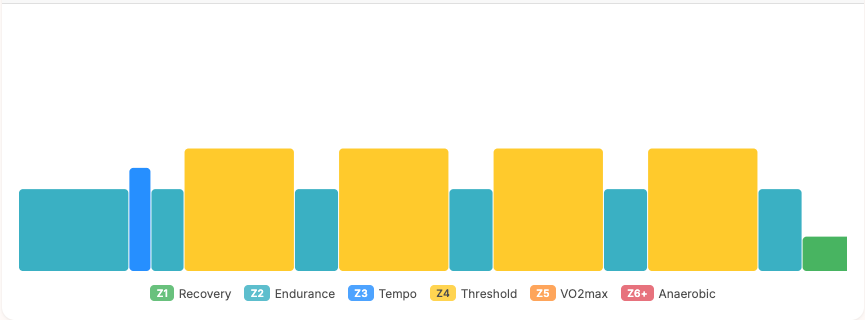
| Time | Duration | Power (% FTP) | Heart Rate | Cadence | Type |
|---|---|---|---|---|---|
| 0:00 | 10 min | 56–75% | ~65–72% max | Free | Warmup |
| 10:00 | 2 min | 75–90% | 72–82% max | Free | Ramp up |
| 12:00 | 3 min | 56–75% | ~68% max | Free | Warmup settle |
| 15:00 | 10 min | 91–105% | 85–92% max | 90–100 rpm | Threshold interval 1 |
| 25:00 | 4 min | 56–75% | ~72% max | Free | Recovery |
| 29:00 | 10 min | 91–105% | 85–92% max | 90–100 rpm | Threshold interval 2 |
| 39:00 | 4 min | 56–75% | ~72% max | Free | Recovery |
| 43:00 | 10 min | 91–105% | 85–92% max | 90–100 rpm | Threshold interval 3 |
| 53:00 | 4 min | 56–75% | ~72% max | Free | Recovery |
| 57:00 | 10 min | 91–105% | 85–92% max | 90–100 rpm | Threshold interval 4 |
| 67:00 | 4 min | 56–75% | ~72% max | Free | Recovery |
| 71:00 | 10 min | 0–55% | ~60% max | Free | Cooldown |
Total work time: 4 × 10 min = 40 minutes at threshold. TSS: 71. At threshold, heart rate typically reaches 85–92% of max by the midpoint of each 10-minute interval and continues rising slightly toward the end — this is normal cardiac drift at this intensity. If you cannot hold target power for the full 10 minutes without HR exceeding 95% of max, your FTP may be slightly overestimated or you are doing this session with insufficient freshness.