
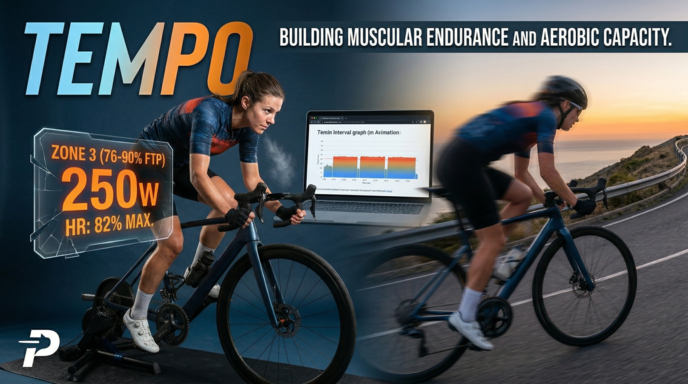
Tempo training is the zone where cycling starts to feel like real effort. It is harder than an endurance ride, easier than an interval session, and it builds a specific type of fitness that neither extreme can replicate. Used correctly, it makes you a stronger, more efficient rider. Used incorrectly, it exhausts you without producing the adaptations you are looking for.
What is tempo training?
Tempo is Zone 3 — typically defined as 76% to 90% of FTP. It sits above comfortable endurance pace and well below the lactate threshold where sustained efforts become genuinely hard. In heart rate terms, most cyclists are in Zone 3 somewhere between 76% and 85% of max heart rate.
The subjective feel is “comfortably hard.” You can still speak in short sentences but not hold a full conversation. You are working continuously and meaningfully, but you are not in distress. A 60-minute tempo ride should feel like solid, sustained effort — not a sprint, not a cruise.
What tempo training does to your body
Tempo work primarily develops your aerobic capacity at moderate-to-high intensities. The key adaptations include improved lactate clearance at higher power outputs, increased mitochondrial density in fast-twitch muscle fibres, improved ability to sustain effort over long climbs and hard group rides, and a higher sustainable power output before you hit your lactate threshold.
Tempo is particularly useful for cyclists who do a lot of road riding with varied terrain — it closely mimics the sustained effort required to hold pace on rolling roads, moderate climbs, and fast group rides. It builds the kind of fitness that shows up on a 3-hour ride with 1,500 metres of climbing, not just in a lab test.
For the average cyclist
For most amateur cyclists, one or two tempo sessions per week is the right amount during a base or build phase. Tempo is more fatiguing than Zone 2 work but less demanding than threshold intervals, which makes it a useful middle ground when you want to add training stress without crushing your recovery.
A good starting point is a 60-minute session with 20 to 30 minutes of sustained tempo effort within a structured warmup and cooldown. As fitness improves, extend the sustained effort — 45 minutes, 60 minutes, eventually 90 minutes of continuous tempo work within a longer ride. The goal is consistent power output throughout — not a strong start that fades.
For the advanced cyclist
Advanced riders use tempo as a supporting zone rather than a primary training stimulus. In a well-structured season, most intensity work sits above tempo — at threshold or VO2max — with tempo used on days when the goal is aerobic maintenance without deep fatigue. Extended tempo sessions of 90 to 120 minutes are also used in late base phase to build the aerobic foundation before more intense blocks begin.
For advanced cyclists who race, tempo work also trains the specific demands of long breakaways, sustained climbs, and hard group ride pacing — efforts that are too hard to sustain at threshold but require more than endurance pace.
The risks of too much tempo
Tempo is the most commonly overdone training zone in amateur cycling. The problem is that it sits in the “grey zone” — hard enough to accumulate significant fatigue, not hard enough to produce the sharpest fitness adaptations. Riders who do most of their riding at tempo often find they are always moderately tired, never fully fresh, and not improving as fast as they should be despite putting in the hours.
The signs of too much tempo are subtle: you feel okay but never great, your hard sessions feel flatter than expected, your recovery time between workouts is longer than it should be, and your power output at low heart rates gradually declines. The fix is to push your easy days genuinely easier and your hard days genuinely harder — the polarized approach.
How to know if you are in tempo
Without a power meter, heart rate is your best guide. Zone 3 heart rate for most cyclists sits between 76% and 85% of max. With a power meter, target 76% to 90% of FTP — a range of about 25 watts for a 250W FTP rider. If your power drifts above 90% FTP, you are moving into sweet spot territory. Below 76%, you are in endurance pace. Both are useful, but neither is tempo.
Tempo workouts in PersonalBestPace
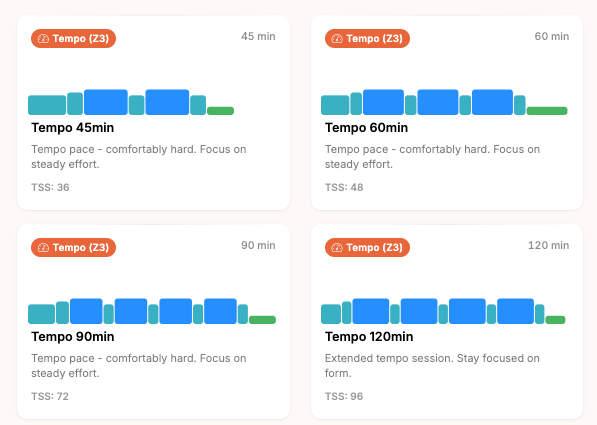
PersonalBestPace includes Tempo workouts from 45 to 120 minutes, structured around steady Zone 3 intervals with warmup and cooldown. The AI coach positions tempo sessions within your weekly plan based on your TSB and upcoming harder sessions — so you never run a tempo day directly into a threshold day without adequate recovery between them.
Try it free at app.personalbestpace.com
Tempo 90min — workout breakdown
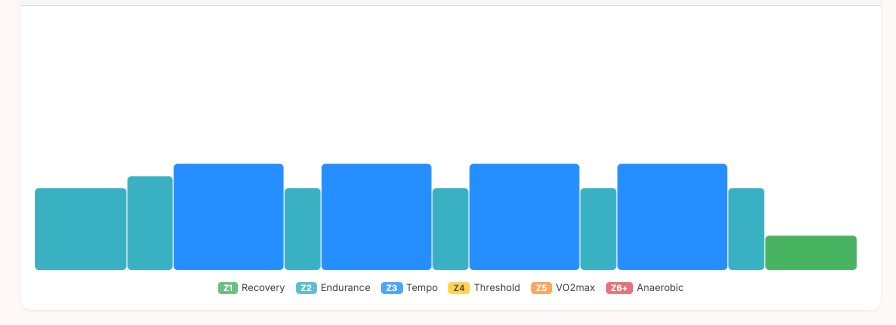
Here is the full segment breakdown for the Tempo 90min workout from PersonalBestPace. Four 12-minute tempo blocks with short recoveries — a classic structure for building sustained aerobic power at Zone 3.
| Time | Duration | Power (% FTP) | Heart Rate | Cadence | Type |
|---|---|---|---|---|---|
| 0:00 | 10 min | 56–75% | ~65–72% max | Free | Warmup |
| 10:00 | 5 min | 66–84% | 72–80% max | Free | Ramp up |
| 15:00 | 12 min | 76–94% | 78–85% max | 85–95 rpm | Tempo interval 1 |
| 27:00 | 4 min | 56–75% | ~70% max | Free | Recovery |
| 31:00 | 12 min | 76–94% | 78–85% max | 85–95 rpm | Tempo interval 2 |
| 43:00 | 4 min | 56–75% | ~70% max | Free | Recovery |
| 47:00 | 12 min | 76–94% | 78–85% max | 85–95 rpm | Tempo interval 3 |
| 59:00 | 4 min | 56–75% | ~70% max | Free | Recovery |
| 63:00 | 12 min | 76–94% | 78–85% max | 85–95 rpm | Tempo interval 4 |
| 75:00 | 4 min | 56–75% | ~70% max | Free | Recovery |
| 79:00 | 10 min | 0–55% | ~60% max | Free | Cooldown |
Total work time: 4 × 12 min = 48 minutes at tempo. TSS: 72. The heart rate guidance is approximate — at tempo pace most cyclists will see HR settle in the 76–85% of max range within the first few minutes of each interval and hold relatively steady. If HR drifts higher than 88% of max during a 12-minute interval, you are working above tempo and should reduce power slightly.