
Two of the Most Important Metrics in Cycling Fitness
If you’ve spent any time training with data, you’ve encountered both VO2 max and threshold power (FTP). Both are critical indicators of cycling performance — but they measure fundamentally different things, and improving one doesn’t automatically improve the other.
Understanding the difference helps you train smarter, prioritize the right workouts, and interpret your fitness data accurately.
What Is VO2 Max?
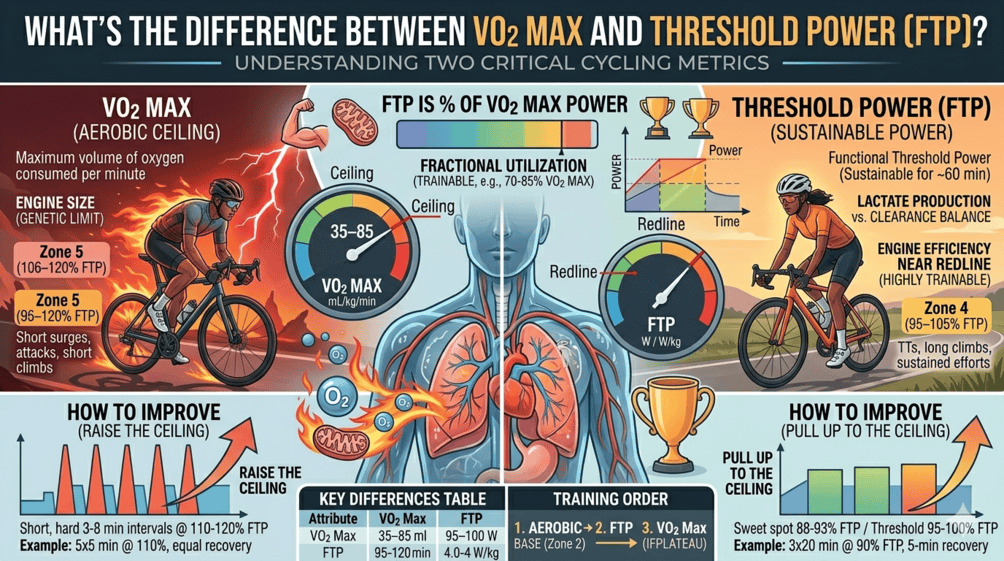
VO2 max is the maximum volume of oxygen your body can consume per minute during intense exercise, expressed in milliliters per kilogram of body weight per minute (mL/kg/min). It represents your aerobic ceiling — the absolute upper limit of your cardiovascular and respiratory system’s ability to deliver and use oxygen.
A typical untrained adult has a VO2 max of 35–40 mL/kg/min. Elite cyclists often exceed 70–80 mL/kg/min. Tour de France contenders have been measured above 85 mL/kg/min.
VO2 max is largely genetic, though training can improve it by 10–20% from baseline. It tends to plateau in experienced athletes, which is why elite riders focus more on other variables like FTP and efficiency.
What Is Threshold Power (FTP)?
FTP (Functional Threshold Power) is the highest average power you can sustain for approximately 60 minutes. It represents the point where lactate production and clearance are balanced — just below the level where lactate starts accumulating faster than your body can remove it.
FTP is highly trainable throughout your cycling career. Unlike VO2 max, it can improve significantly year after year with the right training stimulus, making it the primary focus of most structured cycling programs.
Key Differences: VO2 Max vs. FTP
| Attribute | VO2 Max | FTP (Threshold Power) |
|---|---|---|
| What it measures | Aerobic capacity ceiling | Sustainable power at threshold |
| Unit | mL/kg/min | Watts or W/kg |
| Duration of effort | ~3–8 minutes max | ~60 minutes sustained |
| Trainability | Moderate (partly genetic) | High (very trainable) |
| Training zone | Zone 5 (106–120% FTP) | Zone 4 (95–105% FTP) |
| Best for improving | Short climbs, attacks, surges | TTs, long climbs, sustained efforts |
How Are They Related?
FTP is typically expressed as a percentage of VO2 max power. Most trained cyclists sustain FTP at roughly 70–85% of their VO2 max power output. This percentage — called fractional utilization — is itself trainable: with threshold work, you can raise how close to your VO2 max ceiling you can ride for extended periods.
Think of it this way: VO2 max is the size of your engine. FTP is how efficiently and how long you can run that engine near its redline.
Which Should You Train First?
For most cyclists, the training prescription is:
Build your aerobic base (Zone 2) → Raise FTP with sweet spot/threshold work → Elevate VO2 max with short hard intervals.
Beginners benefit most from Zone 2 and threshold training. Advanced athletes who have plateaued in FTP gains often add structured VO2 max work (5-minute intervals at 110–120% FTP) to raise the ceiling and pull their FTP upward.
How to Improve Each
Improving VO2 Max
Short, very hard intervals of 3–8 minutes at 106–120% FTP with equal rest. Classic workout: 5 × 5 minutes at 110% FTP, 5-minute recovery. Do 1–2 of these sessions per week during a dedicated VO2 block.
Improving FTP
Sweet spot intervals (88–93% FTP), threshold repeats (95–100% FTP), and a strong Zone 2 base. These make up the bulk of any well-designed training plan targeting sustained power improvement.
Frequently Asked Questions
Can I have a high VO2 max but a low FTP?
Yes. This is common in untrained or undertrained athletes who have natural aerobic capacity but haven’t developed the ability to sustain efforts near that ceiling. Threshold training closes the gap.
Which metric predicts cycling performance better?
For events longer than 20–30 minutes, FTP (expressed as W/kg) is a stronger predictor of performance than raw VO2 max. For short, explosive events, VO2 max and anaerobic power matter more.
How do I measure my VO2 max without a lab?
Garmin and some other devices estimate VO2 max from heart rate and power data during rides. These estimates are reasonably accurate for most athletes (within 5–10%) and are updated automatically after hard efforts.