
What Is Polarized Training?
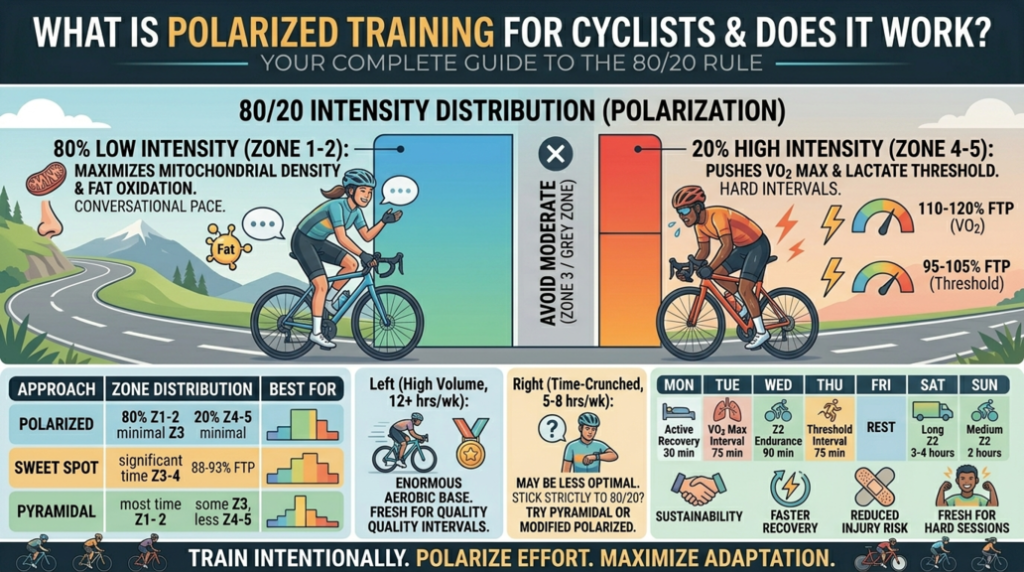
Polarized training is a training intensity distribution model where athletes spend the vast majority of their time at low intensity and a small but significant portion at high intensity — deliberately avoiding the middle “moderate” zone (tempo/sweet spot). The name comes from the polarization between these two ends of the intensity spectrum.
The most cited distribution is 80% low intensity (Zone 1–2) and 20% high intensity (Zone 4–5), with minimal time in the moderate Zone 3 range.
The Science Behind Polarized Training
Sports scientist Dr. Stephen Seiler pioneered research into polarized training after analyzing the training logs of elite endurance athletes across multiple sports. His landmark studies found that world-class cross-country skiers, rowers, cyclists, and runners all naturally gravitated toward an 80/20 intensity distribution — regardless of their coaches’ explicit instructions.
The physiological reasoning is compelling: low-intensity Zone 2 riding maximizes mitochondrial density and fat oxidation with minimal recovery cost. High-intensity Zone 4–5 intervals push your VO2 max and lactate threshold. Moderate Zone 3 work is metabolically costly but doesn’t provide the same adaptations as either extreme — often called the “grey zone” because it’s too hard to allow full recovery and too easy to drive top-end adaptations.
Polarized vs. Sweet Spot Training: What’s the Difference?
| Approach | Zone Distribution | Best For |
|---|---|---|
| Polarized | 80% Z1–2, 20% Z4–5, minimal Z3 | High-volume athletes, long-term development |
| Sweet Spot | Significant time at Z3–4 (88–93% FTP) | Time-crunched cyclists, FTP gains |
| Pyramidal | Most time Z1–2, some Z3, less Z4–5 | Moderate-volume recreational cyclists |
Does Polarized Training Work for Amateur Cyclists?
Yes — with an important caveat. The research on polarized training is strongest for high-volume athletes (those training 12+ hours per week). When you have enough volume, spending 80% of it at low intensity still means a large absolute number of easy hours, which builds an enormous aerobic base.
For time-crunched cyclists training 5–8 hours per week, pure polarized training may be less optimal. At lower volumes, spending only 1–1.5 hours per week at high intensity may not provide enough training stimulus. Many coaches recommend a modified approach — closer to a pyramidal or sweet spot-dominant plan — for athletes with limited training time.
A Sample Polarized Training Week (10 Hours)
Monday: Rest or active recovery (30 min Zone 1)
Tuesday: VO2 max intervals — 5 × 4 min at Zone 5, 4 min recovery (75 min total)
Wednesday: Zone 2 endurance ride (90 min)
Thursday: Threshold intervals — 3 × 10 min at Zone 4, 5 min recovery (75 min total)
Friday: Rest
Saturday: Long Zone 2 ride (3–4 hours)
Sunday: Medium Zone 2 ride (2 hours)
Key Benefits of Polarized Training
Polarized training’s main advantages are its sustainability and recovery profile. Because Zone 2 riding is genuinely easy, athletes can accumulate large volumes without excessive fatigue. This means they arrive at hard interval sessions fresh enough to execute them at full quality — which is where the real performance gains happen.
It also reduces injury risk and burnout compared to training plans that keep athletes in the medium-hard zone day after day.
Frequently Asked Questions
How do I know if I’m riding easy enough for Zone 2?
You should be able to hold a full conversation without difficulty. Nose breathing only is a useful field test. On a power meter, Zone 2 is 56–75% of your FTP — many cyclists ride this harder than they think.
Should beginners use polarized training?
Beginners benefit from almost any consistent training, but polarized principles are a sound foundation. Start with mostly easy riding and gradually introduce structured intervals once you have 2–3 months of consistent base training.
Can I do polarized training on a time-crunched schedule?
Yes, but modify the approach. With limited hours, increase the proportion of high-intensity sessions (perhaps 25–30% of total time) rather than strictly adhering to the 80/20 split designed for high-volume athletes.