
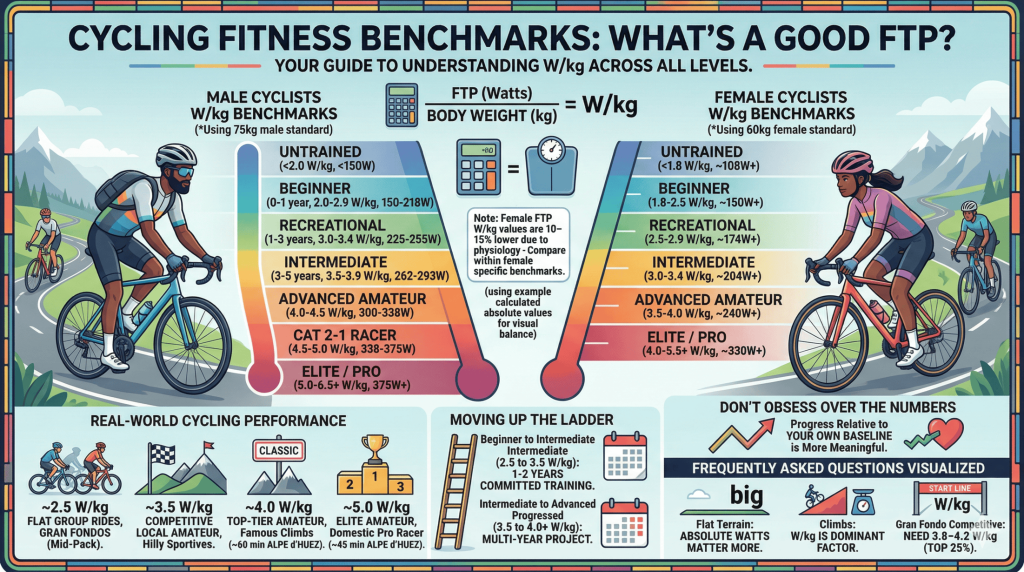
Understanding FTP Benchmarks
Functional Threshold Power (FTP) means very little in isolation. A 200W FTP is excellent for a 90kg rider and mediocre for a 60kg one. This is why the universal benchmark for comparing cycling fitness is watts per kilogram (W/kg) — FTP divided by body weight in kilograms.
W/kg normalizes power for body size and is the metric used by coaches, racing platforms, and athletes worldwide to gauge cycling fitness level.
FTP Benchmarks: What’s Good at Each Level?
Male Cyclists — FTP W/kg Benchmarks
| Category | W/kg (FTP) | Absolute FTP (75kg rider) |
|---|---|---|
| Untrained | < 2.0 W/kg | < 150W |
| Beginner (0–1 year) | 2.0–2.9 W/kg | 150–218W |
| Recreational (1–3 years) | 3.0–3.4 W/kg | 225–255W |
| Intermediate (3–5 years) | 3.5–3.9 W/kg | 262–293W |
| Advanced Amateur | 4.0–4.5 W/kg | 300–338W |
| Cat 2–1 Racer | 4.5–5.0 W/kg | 338–375W |
| Elite / Pro | 5.0–6.5+ W/kg | 375W+ |
Female Cyclists — FTP W/kg Benchmarks
| Category | W/kg (FTP) |
|---|---|
| Untrained | < 1.8 W/kg |
| Beginner | 1.8–2.5 W/kg |
| Recreational | 2.5–2.9 W/kg |
| Intermediate | 3.0–3.4 W/kg |
| Advanced Amateur | 3.5–4.0 W/kg |
| Elite / Pro | 4.0–5.5+ W/kg |
Note: Female cyclists typically have FTP W/kg values roughly 10–15% lower than males due to differences in muscle fiber composition and hormone profiles — not fitness level. Women should compare themselves to female-specific benchmarks.
How to Calculate Your FTP W/kg
Divide your FTP in watts by your weight in kilograms. Example: 260W FTP ÷ 72kg = 3.61 W/kg — solidly intermediate.
What These Numbers Mean in Real-World Riding
2.5 W/kg: Comfortable on flat group rides, struggles to hold the wheel on moderate climbs, completes gran fondos but finishes in the middle of the pack.
3.5 W/kg: Competitive in local amateur events, climbs well, can complete hilly sportives at a strong pace.
4.0 W/kg: Top-tier amateur, competitive in local races, can complete famous climbs (Alpe d’Huez in ~60 minutes).
5.0 W/kg: Elite amateur or professional domestic racer level. Alpe d’Huez in ~45 minutes.
How Quickly Can You Move Up the Ladder?
With consistent structured training, most cyclists can move up one category level within a full training season (8–12 months). Going from beginner to intermediate (2.5 to 3.5 W/kg) typically takes 1–2 years of committed training. Moving from intermediate to advanced (3.5 to 4.0+ W/kg) is a multi-year project for most athletes.
Don’t Obsess Over the Numbers
FTP benchmarks are useful reference points, not judgments of your worth as a cyclist. Progress relative to your own baseline is more meaningful than comparison to others. A 10% FTP improvement over a training season represents significant, real fitness development — regardless of where you fall on the benchmark table.
Frequently Asked Questions
Is 3.0 W/kg good for a beginner?
Yes — 3.0 W/kg puts you at the recreational level after just one year of training, which is excellent progress. Many cyclists train for 2–3 years before reaching this level.
What W/kg do I need to ride a gran fondo competitively?
Most gran fondos are completed comfortably at 3.0–3.5 W/kg. To finish in the top 25% of a competitive gran fondo, you typically need 3.8–4.2 W/kg.
Does body weight really affect FTP that much?
On flat terrain, absolute watts matter more. On climbs, W/kg is the dominant factor — lighter riders have a significant advantage per unit of power on ascents. This is why the best climbers in professional cycling often have W/kg values of 6.0–6.5 during key mountain efforts.