
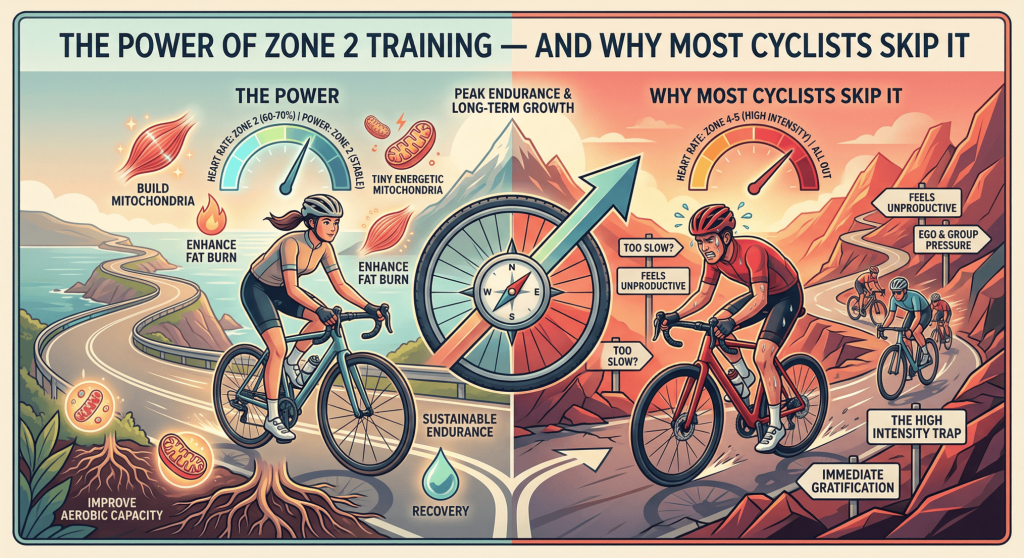
Tell a motivated cyclist to spend an hour riding at a pace where they can hold a full conversation, and most will nod along — then promptly ignore the advice the moment they clip in. Zone 2 feels too easy. It feels like not trying. It feels like a waste of time.
It isn’t. In fact, it might be the single most underused performance lever in amateur cycling.
What Is Zone 2, Exactly?
Zone 2 is the low-to-moderate intensity band where your body primarily uses fat as fuel and your aerobic system is working — but not straining. For most cyclists, this sits around 60–70% of max heart rate, or a pace where you can speak in full sentences but wouldn’t want to sing. It’s genuinely, deliberately slow.
Why It Works
Zone 2 training targets your mitochondria — the tiny cellular engines that produce energy. The more mitochondria you have, and the more efficiently they function, the more power you can sustain over long efforts before fatigue sets in. You’re essentially building a bigger, cleaner engine.
World Tour cyclists spend the majority of their training hours here. Not because it’s fun, but because the science is unambiguous: a deep aerobic base makes everything else better — your threshold, your climbing, your ability to recover between hard efforts.
Why Cyclists Skip It
Zone 2 is humbling. You have to slow down. You might get passed on a bike path. Your Strava segment times will look unimpressive. The ego takes a hit that the data doesn’t justify.
There’s also a practical misconception: many riders think they’re in Zone 2 when they’re actually drifting into Zone 3 — that “moderate” gray zone that’s too hard to be truly restorative and too easy to drive real adaptation. True Zone 2 requires honest self-restraint.
How to Start Doing It Right
Commit one or two rides per week to genuine Zone 2 work. Use a heart rate monitor to keep yourself honest — your target HR should feel almost embarrassingly low. Expect your power to drop initially. That’s fine. Over weeks and months, you’ll notice your power output climbing at the same heart rate, which is exactly what improved aerobic efficiency looks like.
Be patient. The athletes who embrace the slow rides are the ones who go fast when it counts.