

Sweet spot training is one of the most effective tools in a cyclist’s training programme. Sitting just below threshold, it delivers a high training stimulus per hour of effort — which is why time-crunched riders and serious racers alike use it as a cornerstone of their training. But like most effective tools, it has to be used correctly.
What is sweet spot training?
Sweet spot sits between Zone 3 (tempo) and Zone 4 (threshold) — typically defined as 88% to 93% of FTP. It earns its name because it sits at the point on the training stress curve where the ratio of adaptation to fatigue is at its best. You are working hard enough to produce significant fitness gains, but not so hard that recovery takes days.
The effort level feels hard but sustainable. You should be breathing noticeably — short sentences only — and your legs will feel the effort by the end of each interval. A typical sweet spot session involves repeated intervals of 10 to 20 minutes at this intensity with short recoveries between them.
What sweet spot training does to your body
Sweet spot training is primarily an FTP builder. The sustained high aerobic stress drives significant adaptations in your aerobic enzyme activity, mitochondrial density, and lactate clearance capacity. Over a 6 to 8 week block, consistent sweet spot work reliably raises FTP for most cyclists — particularly those who have not previously trained systematically at this intensity.
The other major benefit is efficiency. Because sweet spot sits below true threshold, you can accumulate more time at high aerobic intensity per week than you could with pure threshold intervals. A 90-minute sweet spot session produces more total training stress than a 60-minute threshold session, with comparable recovery demands. This makes sweet spot particularly valuable for riders who want to build fitness without requiring a full rest day after every hard session.
For the average cyclist
For riders training 6 to 10 hours per week, sweet spot is the most time-efficient way to raise FTP. A programme of two sweet spot sessions per week — one shorter session (60 to 75 minutes) and one longer session (90 to 120 minutes) — combined with 2 to 3 Zone 2 rides will produce consistent fitness gains over an 8-week block.
The critical discipline is staying in the zone. Sweet spot that drifts up into threshold intensity becomes threshold work with more accumulated fatigue. Sweet spot that drifts down to tempo loses much of its effectiveness. A power meter and discipline to stay in the 88% to 93% FTP range throughout each interval is what separates productive sweet spot sessions from grey-zone riding.
For the advanced cyclist
Advanced cyclists use sweet spot primarily in their base and early build phases, before transitioning to more race-specific work at threshold and above. Extended sweet spot sessions — 120 to 150 minutes — are used to build the aerobic ceiling before shifting into higher-intensity blocks. During peak and race phases, sweet spot volume typically drops as sharper threshold and VO2max work takes priority.
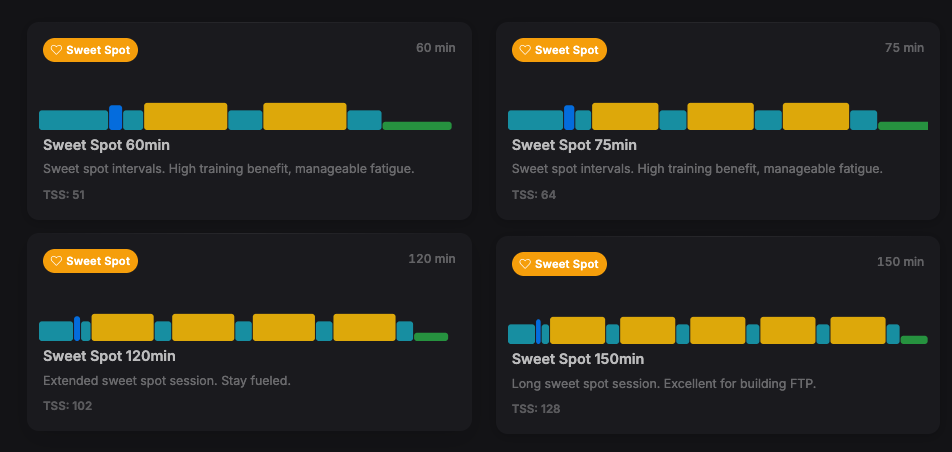
For experienced riders, the 150-minute sweet spot session is a particularly effective training stimulus — it produces high total TSS (around 128) while remaining recoverable within 48 hours for most trained athletes.
What happens when you overdo sweet spot
Sweet spot is deceptively fatiguing. Because it feels hard but manageable, riders often stack too many sessions in a week without adequate recovery. The result is cumulative fatigue that typically shows up 2 to 3 weeks in as declining performance, heavy legs at low power outputs, and difficulty hitting target power even when you feel mentally motivated.
A practical rule: no more than 2 sweet spot sessions per week, with at least one full recovery or Zone 2 day between each. Monitor your TSB — if it drops below -20 and stays there, your sweet spot volume is too high for your current recovery capacity. Back off for a week, let your TSB recover toward zero, and return to the sessions with better quality.
Sweet spot workouts in PersonalBestPace
PersonalBestPace includes Sweet Spot workouts from 60 to 150 minutes, structured around intervals targeting 88 to 93% FTP with timed recoveries between efforts. The AI coach schedules sweet spot sessions within your week based on your fitness, fatigue, and recent training load — ensuring you always arrive at these sessions with enough freshness to actually stay in the zone throughout.
Try it free at app.personalbestpace.com
Sweet Spot 120min — workout breakdown
Here is the full segment breakdown for the Sweet Spot 120min workout from PersonalBestPace — the extended session referenced in this article. Four 18-minute sweet spot blocks with 5-minute recoveries between them. TSS: 102.
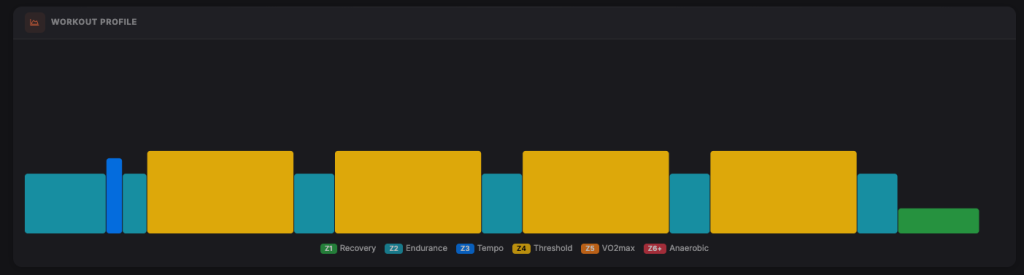
| Time | Duration | Power (% FTP) | Heart Rate | Cadence | Type |
|---|---|---|---|---|---|
| 0:00 | 10 min | 56–75% | ~65–72% max | Free | Warmup |
| 10:00 | 2 min | 75–90% | 72–80% max | Free | Ramp up |
| 12:00 | 3 min | 56–75% | ~68% max | Free | Warmup settle |
| 15:00 | 18 min | 88–93% | 80–87% max | 85–95 rpm | Sweet spot interval 1 |
| 33:00 | 5 min | 56–75% | ~70% max | Free | Recovery |
| 38:00 | 18 min | 88–93% | 80–87% max | 85–95 rpm | Sweet spot interval 2 |
| 56:00 | 5 min | 56–75% | ~70% max | Free | Recovery |
| 61:00 | 18 min | 88–93% | 80–87% max | 85–95 rpm | Sweet spot interval 3 |
| 79:00 | 5 min | 56–75% | ~70% max | Free | Recovery |
| 84:00 | 18 min | 88–93% | 80–87% max | 85–95 rpm | Sweet spot interval 4 |
| 102:00 | 5 min | 56–75% | ~70% max | Free | Recovery |
| 107:00 | 10 min | 0–55% | ~60% max | Free | Cooldown |
Total work time: 4 × 18 min = 72 minutes at sweet spot. TSS: 102. Heart rate typically reaches 80–87% of max within the first 4–5 minutes of each interval and holds steady. A gradual drift of 1–2% HR over the course of the session is normal. If HR climbs above 90% of max during an interval, reduce power slightly — you have moved into threshold territory.