
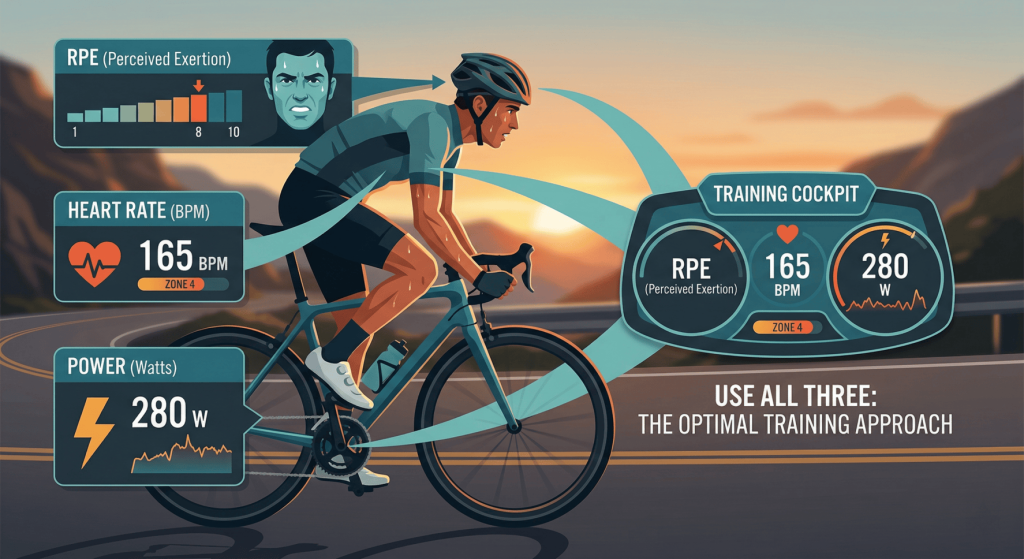
Three Tools, Three Approaches to Training
Every cyclist faces the same question when they start training with structure: which metric should guide my effort? Rate of Perceived Exertion (RPE), heart rate, and power each have genuine strengths and real limitations. The best choice depends on your budget, experience level, and training goals — and many cyclists use all three in combination.
Rate of Perceived Exertion (RPE)
What It Is
RPE is a subjective scale measuring how hard you feel you’re working. The most common version is the 1–10 scale: 1 is sitting still, 10 is an absolute maximum sprint. The Borg 6–20 scale is used in clinical settings. For cycling, a simple 1–10 scale is most practical.
Pros
Free — no equipment needed. Automatically accounts for daily variation in fatigue, sleep, heat, and illness. Studies show that experienced athletes are surprisingly accurate at self-calibrating effort. RPE is the only metric that integrates your full physiological state, not just one variable.
Cons
Highly subjective and unreliable for beginners who haven’t calibrated their effort perception. Can’t be compared across riders or analyzed retrospectively. Easy to sandbag or push too hard without realizing it.
Best For
Beginners learning to feel effort levels, experienced athletes on recovery days, and situations where devices fail. Also useful as a secondary check on power or heart rate data.
Heart Rate Training
What It Is
Heart rate monitors measure cardiac output in beats per minute (bpm). Training zones are set as percentages of maximum heart rate (MHR) or threshold heart rate (LTHR).
Pros
Relatively inexpensive (chest straps start at $30–50, optical wrist monitors from $80). Provides objective, reproducible data. Excellent for long endurance rides where sustained aerobic effort matters. Reflects cardiovascular strain accurately on consistent, steady-state efforts.
Cons
Significant lag: heart rate takes 30–60+ seconds to respond to changes in effort, making it useless for precise short interval work. Affected by heat, humidity, caffeine, dehydration, and cumulative fatigue (cardiac drift). Optical wrist sensors are notably less accurate than chest straps at high intensities.
Best For
Zone 2 endurance rides, long steady-state efforts, recovery monitoring, and athletes who can’t afford a power meter. Excellent for ensuring you don’t ride too hard on easy days.
Power Training
What It Is
Power meters measure your actual mechanical output in watts — the force you apply to the pedals multiplied by your cadence. This is the most direct measure of cycling performance available outside a laboratory.
Pros
Instantaneous and precise — responds immediately to effort changes with zero lag. Unaffected by heat, fatigue, or external conditions (a watt is always a watt). Enables precise interval execution, FTP testing, race pacing, and long-term performance tracking. The gold standard of cycling training metrics.
Cons
Cost: quality power meters start at $200–$300 for single-sided crank or pedal units. Requires calibration. Doesn’t account for acute fatigue state — you might hit your target watts on a bad day but at significantly higher physiological cost.
Best For
All structured interval work, FTP testing, race pacing, time trials, and any rider who trains seriously and wants maximum precision.
The Best Approach: Use All Three
Elite coaches rarely rely on a single metric. The optimal approach is to train primarily by power, use heart rate to monitor aerobic drift and fatigue, and check RPE to validate that your body agrees with the numbers.
If your power is on target but heart rate is elevated and RPE feels harder than usual — that’s your body telling you something the numbers alone can’t: you need more recovery.
Frequently Asked Questions
Can I train effectively with only a heart rate monitor?
Yes, absolutely. Millions of cyclists have built excellent fitness using heart rate zones. The limitations become more significant as you advance and want finer control over interval precision.
Is a power meter worth the cost for a recreational cyclist?
If you train more than 6 hours per week and want to improve systematically, yes. A power meter pays dividends in training precision and motivation that far outweigh the cost over years of use.
Which is better for racing: power or heart rate?
Power, decisively. For pacing a time trial or controlling effort on a long climb, real-time power is far more reliable than heart rate, which lags behind effort and can be misleading in race conditions.