
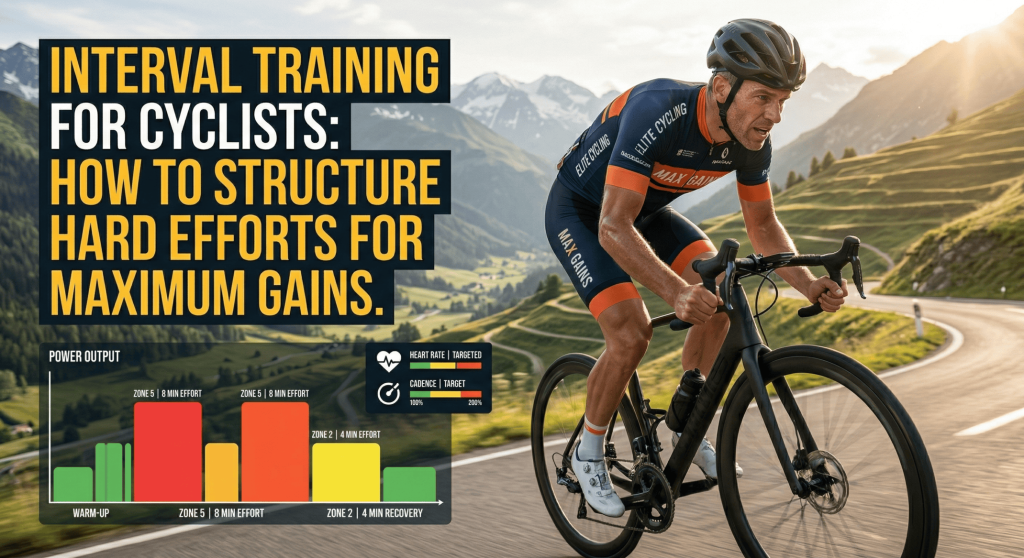
Interval training is the umbrella term for any workout that alternates between periods of hard effort and recovery. It spans everything from 40-second VO2max bursts to 20-minute threshold blocks, and it underpins most of the fitness gains that come from structured cycling training. Understanding how intervals work — and how to use them correctly — is the most direct path to getting faster.
Why intervals work
The core principle is straightforward: you can accumulate more time at high intensity through intervals than through continuous effort. A cyclist who can sustain 5 minutes at VO2max can do 5 repeats of 5 minutes with recovery between them, producing 25 minutes of VO2max stimulus in a single session. Without recovery intervals, 25 continuous minutes at that intensity would be impossible. The recovery between efforts is not wasted time — it is what makes each subsequent hard effort achievable at full quality.
Types of intervals and what they target
Different interval structures target different physiological systems. Short, high-intensity intervals (20 to 60 seconds) primarily stress the anaerobic and neuromuscular systems — the 40-20 format is a classic example. Medium-length intervals (3 to 8 minutes) at VO2max intensity target your aerobic ceiling. Longer intervals (8 to 20 minutes) at threshold or sweet spot build sustainable power and raise FTP. The right structure depends entirely on your current training phase and what you are trying to improve.
[SCREENSHOT: PersonalBestPace workout library — multiple interval types visible including Sweet Spot, Threshold Z4, VO2max Z5, 40-20 Intervals from app.personalbestpace.com/workouts]
How to structure intervals in your training week
The most common mistake with interval training is mixing too many different types in the same week. Combining VO2max intervals on Tuesday with threshold work on Thursday and sweet spot on Saturday produces scattered stimuli that are difficult for the body to adapt to specifically. It is more effective to focus on one intensity zone per training block — 4 to 6 weeks of primarily sweet spot work, then a block of threshold work, then a block of VO2max — rather than attempting a bit of everything every week.
A practical weekly structure for an amateur cyclist training 3 to 4 rides per week: one interval session (the hard session of the week), one medium-intensity ride (tempo or sweet spot), and one to two Zone 2 endurance rides. Vary the interval type across your training blocks but keep each individual week focused on one stimulus.
Recovery intervals matter as much as work intervals
A common error among self-coached riders is cutting recovery intervals short to make the session feel harder. This is counterproductive. The recovery interval is what allows the next work interval to be executed at target intensity and quality. Shortening recovery produces a different physiological stimulus — it turns a VO2max session into something closer to lactate tolerance work, which may or may not be what you need at that point in your season. Follow the prescribed recovery durations and trust the structure.
For the average cyclist
One structured interval session per week is sufficient for most cyclists training 6 to 8 hours per week. Attempting two hard interval sessions in the same week without adequate recovery capacity typically results in the second session being lower quality — which reduces its training value while still accumulating fatigue. One excellent interval session per week consistently beats two mediocre ones.
Freshness before a hard interval session matters more than most riders realise. If your TSB is deeply negative when you start a threshold or VO2max session, you will not hit target power, and the session becomes an exercise in suffering rather than a targeted training stimulus. Use your fitness data to time hard sessions correctly.
For the advanced cyclist
Advanced cyclists can sustain two or even three interval sessions per week in specific training phases, but they support this with high Zone 2 volume, careful recovery monitoring, and structured rest weeks every third or fourth week. The key differentiator between advanced and amateur training is not doing more hard intervals — it is recovering better from the ones they do, and ensuring the quality of each session remains high throughout the block.
Interval workouts in PersonalBestPace
PersonalBestPace’s workout library covers the full interval spectrum — from 30-minute 40-20 anaerobic sessions and Tabata intervals through to 90-minute extended threshold blocks. The AI coach selects and schedules the right interval type based on your current training phase, fitness level, and TSB. You arrive at every hard session with enough freshness to execute it properly — because the AI coach has been managing your fatigue all week to make sure that happens.
Try it free at app.personalbestpace.com
Three interval sessions compared — workout breakdowns
To show how interval structure changes across training zones, here are three contrasting sessions from PersonalBestPace — a sweet spot session, a threshold session, and a VO2max session. Same warmup and cooldown, very different interval patterns.
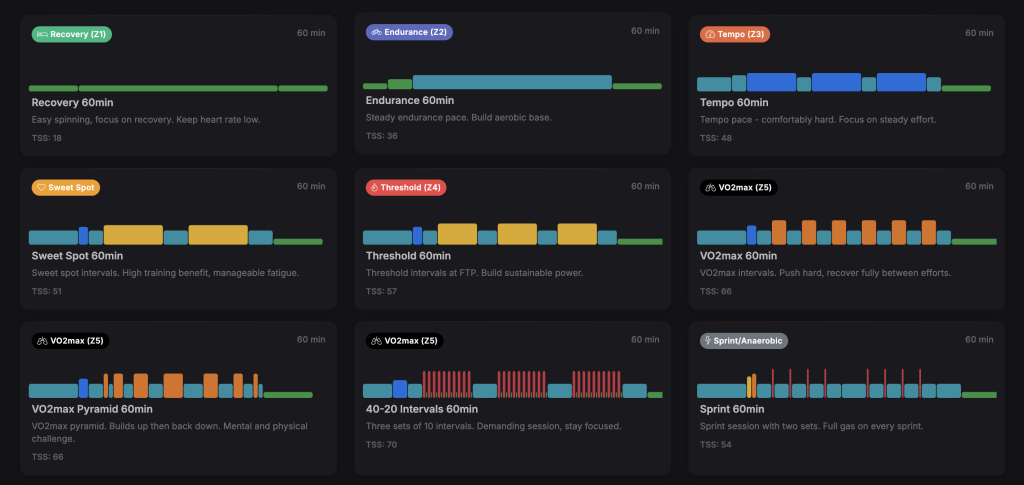
Sweet Spot 75min — moderate intensity, long intervals
| Time | Duration | Power (% FTP) | Heart Rate | Cadence | Type |
|---|---|---|---|---|---|
| 0:00 | 15 min | 56–90% | 65–80% max | Free | Warmup + ramp |
| 15:00 | 12 min | 88–93% | 80–87% max | 85–95 rpm | Sweet spot interval 1 |
| 27:00 | 5 min | 56–75% | ~70% max | Free | Recovery |
| 32:00 | 12 min | 88–93% | 80–87% max | 85–95 rpm | Sweet spot interval 2 |
| 44:00 | 5 min | 56–75% | ~70% max | Free | Recovery |
| 49:00 | 12 min | 88–93% | 80–87% max | 85–95 rpm | Sweet spot interval 3 |
| 61:00 | 5 min | 56–75% | ~70% max | Free | Recovery |
| 66:00 | 10 min | 0–55% | ~60% max | Free | Cooldown |
Threshold 75min — high intensity, medium intervals
| Time | Duration | Power (% FTP) | Heart Rate | Cadence | Type |
|---|---|---|---|---|---|
| 0:00 | 15 min | 56–90% | 65–82% max | Free | Warmup + ramp |
| 15:00 | 10 min | 91–105% | 85–92% max | 90–100 rpm | Threshold interval 1 |
| 25:00 | 4 min | 56–75% | ~72% max | Free | Recovery |
| 29:00 | 10 min | 91–105% | 85–92% max | 90–100 rpm | Threshold interval 2 |
| 39:00 | 4 min | 56–75% | ~72% max | Free | Recovery |
| 43:00 | 10 min | 91–105% | 85–92% max | 90–100 rpm | Threshold interval 3 |
| 53:00 | 4 min | 56–75% | ~72% max | Free | Recovery |
| 57:00 | 10 min | 91–105% | 85–92% max | 90–100 rpm | Threshold interval 4 |
| 67:00 | 8 min | 0–75% | ~60% max | Free | Cooldown |
VO2max 60min — maximum intensity, short intervals
| Time | Duration | Power (% FTP) | Heart Rate | Cadence | Type |
|---|---|---|---|---|---|
| 0:00 | 15 min | 56–97% | 65–85% max | Free | Warmup + ramp |
| 15:00 | 3 min | 106–120% | 88–96% max | 95–105 rpm | VO2max interval 1 |
| 18:00 | 3 min | 56–75% | ~74% max | Free | Recovery |
| 21:00 | 3 min | 106–120% | 90–97% max | 95–105 rpm | VO2max interval 2 |
| 24:00 | 3 min | 56–75% | ~74% max | Free | Recovery |
| 27:00–45:00 | 3+3 min ×3 | 106–120% / 56–75% | 90–97% / ~74% | 95–105 / Free | Intervals 3–5 + recoveries |
| 45:00 | 3 min | 106–120% | 90–97% max | 95–105 rpm | VO2max interval 6 |
| 48:00 | 13 min | 0–75% | ~60% max | Free | Recovery + cooldown |
The pattern is clear across all three: as intensity rises, interval duration drops and recovery length relative to work time increases. Sweet spot uses long intervals with short recoveries. Threshold uses medium intervals with moderate recoveries. VO2max uses short intervals with equal-length recoveries. Each structure is calibrated to what the body can sustain at that intensity while producing quality effort throughout.