How to Track Cycling Progress Without a Power Meter
April 11, 2026

How to Track Cycling Progress Without a Power Meter

Can You Track Cycling Progress Without a Power Meter? Absolutely. While a power meter is the gold standard for measuring cycling performance, it’s not a requirement for tracking meaningful progress. Millions of cyclists improve consistently using free or low-cost tools that, when used correctly, provide reliable performance data and training structure. Method 1: Strava Segments […]

What Is TSS (Training Stress Score) and How Do You Use It?
April 10, 2026

What Is TSS (Training Stress Score) and How Do You Use It?

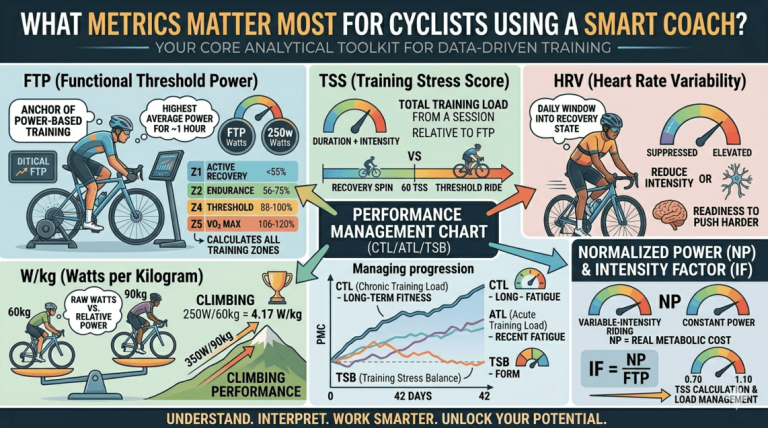
What Is Training Stress Score (TSS)? Training Stress Score (TSS) is a numerical measure of the total training load from a single workout, developed by Dr. Andrew Coggan and Hunter Allen. It combines both the intensity and the duration of a ride into a single number that allows you to compare the physiological cost of […]

How to Structure a 12-Week Cycling Training Plan
April 10, 2026

How to Structure a 12-Week Cycling Training Plan

Why 12 Weeks Is the Sweet Spot for Structured Training A 12-week training block is long enough to drive meaningful physiological adaptation — mitochondrial growth, FTP improvement, and endurance development all require 8–12 weeks of progressive stimulus to fully manifest. It’s also short enough to maintain focus, adjust to life circumstances, and retest your fitness […]

What Is a Good FTP for a Beginner, Intermediate, and Advanced Cyclist?
April 9, 2026

What Is a Good FTP for a Beginner, Intermediate, and Advanced Cyclist?

Understanding FTP Benchmarks Functional Threshold Power (FTP) means very little in isolation. A 200W FTP is excellent for a 90kg rider and mediocre for a 60kg one. This is why the universal benchmark for comparing cycling fitness is watts per kilogram (W/kg) — FTP divided by body weight in kilograms. W/kg normalizes power for body […]

April 9, 2026

How Long Does It Take to Improve Cycling FTP?

The Timeline for FTP Improvement One of the most common questions from cyclists starting structured training is: how long until I see real FTP gains? The honest answer depends on your current fitness level, training history, and the quality of your training plan — but science and coaching experience give us clear guidelines. FTP Improvement […]

zone 2
April 8, 2026

Zone 2 Cycling Training: What It Is and Why Coaches Love It

What Is Zone 2 Training in Cycling? Zone 2 training refers to riding at a low-to-moderate intensity that corresponds to 56–75% of your FTP (Functional Threshold Power) or approximately 60–70% of your maximum heart rate. At this effort level, you can hold a full conversation, breathe easily, and feel like you could continue for hours […]

What Is Polarized Training for Cyclists and Does It Work?
April 8, 2026

What Is Polarized Training for Cyclists and Does It Work?

What Is Polarized Training? Polarized training is a training intensity distribution model where athletes spend the vast majority of their time at low intensity and a small but significant portion at high intensity — deliberately avoiding the middle “moderate” zone (tempo/sweet spot). The name comes from the polarization between these two ends of the intensity […]

how many hours should i train to cycle
April 7, 2026

How Many Hours a Week Should a Cyclist Train?

The Most Common Question in Cycling Training There is no single correct answer to how many hours a week a cyclist should train — it depends entirely on your current fitness level, goals, available time, life stress, and recovery capacity. However, there are well-established guidelines that apply to the vast majority of recreational and amateur […]

What's the Difference Between VO2 Max and Threshold Power?
April 7, 2026

What’s the Difference Between VO2 Max and Threshold Power?

Two of the Most Important Metrics in Cycling Fitness If you’ve spent any time training with data, you’ve encountered both VO2 max and threshold power (FTP). Both are critical indicators of cycling performance — but they measure fundamentally different things, and improving one doesn’t automatically improve the other. Understanding the difference helps you train smarter, […]

April 6, 2026

What is sweet spot training in cycling?

If you’ve been cycling for a while or following a structured training plan, you’ve likely heard the term “sweet spot training.” It’s one of the most popular and effective training methods in cycling — and for good reason. But what exactly is it, and why do so many coaches and athletes swear by it? Defining […]

April 6, 2026

How to Calculate Your Cycling Training Zones at Home

Why Training Zones Matter Cycling training zones divide your effort levels into distinct physiological ranges, each targeting different energy systems and producing different adaptations. Training in the right zone at the right time is what separates structured, progressive fitness improvement from aimless riding. The good news: you can calculate your zones at home with nothing […]

April 6, 2026

What Is FTP in Cycling and How Do You Improve It?

What Is FTP in Cycling? FTP, or Functional Threshold Power, is the highest average power output (measured in watts) you can sustain for approximately 60 minutes. It is the single most important metric in cycling training because it defines the boundary between your aerobic and anaerobic energy systems — and virtually every training zone is […]

April 4, 2026

How do I improve my FTP with AI coaching?

If you’re a cyclist looking to push your performance to the next level, improving your Functional Threshold Power (FTP) is one of the most impactful things you can do. And today, AI coaching is making that process smarter, faster, and more personalized than ever before. What Is FTP and Why Does It Matter? FTP is […]